Just for a change, a few snippets from the Sheppey's aviation history that I compiled some years ago, with the addition of a lot of photos that ex-servicemen sent to me with their memories of serving there.
By the time that WW1 started, Eastchurch was the home of Sheppey's only airfield and remained that way until it finally closed in 1946.However, throughout that time, the MOD still retained the original Leysdown landing ground and it's few buildings, that had once been the home of the Aero Club and Shorts Bros. aircraft factory. It covered most of the land that now forms Leysdown Coastal Park, the stables and out into the farmland alongside. Through the middle of the Landing Ground ran the narrow Wing Road that ran from the back of Leysdown almost to Muswell Manor. Two thirds of Wing Road is now mostly a grassy track used by dog walkers.
Charlie Ward began his Service life at Eastchurch in 1916 and after his initial training he began his service career proper by working in the Coppersmith's shop at Eastchurch airfield. When I spoke to him in 1984 he was in his 70's and still living in Kent and recalled being sent to the Leysdown ranges during WW1 in order to carry out two particular tasks. Many old and un-airworthy aircraft had been lined up on the landing strip there to form a large cross at which practising bomber aircraft would drop their dummy bombs. It was Charlie's job to briefly mark the dropped bomb with a white flag in order to give the bomb aimer or pilot an idea of his accuracy - real high tech. stuff.
Secondly, he was also responsible for a team of men who recovered pebbles and the like from the adjacent Leysdown beach to build what became Wing Road.
During 1922 an Air Armament and Gunnery School was set up at the Eastchurch airfield and a lot of their training in the use of machine guns and bombs in aircraft was to take place at the Leysdown Ranges. As a result, more buildings were quickly built there including Officers bungalows, airmens' quarters and various other ancillary buildings and there was also an attendant Ambulance and Fire Tender. These were all supervised by a Range Warden who lived in a specially built house on the Ranges. About a mile off shore there was a line of coloured buoys and these were also used as targets by the aircraft as they carried out their practice flights. These targets were maintained and patrolled by an RAF launch, the "Adstral", which was moored overnight at Harty Ferry.
These ranges were still providing the same training function to aircraft in WW2 and during 1944 saw several Typhoon squadrons attend for rocket-projectile practise.
Below you can see an ariel photo of the Leysdown Ranges prior to 1930, with the sea in the top LH corner. The large shed in the middle of the photo held a number of observation balloons at one time and in 1930 was dismantled and sent to Hendon. Unfortunately the original was of poor quality but if you click on it once it should come up marginally better.
During the late 1970's/early 1980's the foundations of most of the buildings on the farmland were dug up and the land ploughed over for crops but in 1983, on what was soon to become the Coastal Park, I found the last Stanton-type air raid shelter left there and the base of the large shed removed in 1930.
One last photo from the Leysdown Ranges was taken in 1939. Armourer Richard Moss, who was stationed at Eastchurch before and during WW2, sent it to me. It shows him at the Leysdown Ranges alongside a prototype armoured car known as the "Armadillo", which was at the ranges for tests. We clearly still had some way to go ahead of a possible German invasion!
And so, both between the wars and during WW2, the Leysdown ranges remained a busy and restricted military area as various squadrons used them for aircrew training purposes and at least two fatal accidents took place there.
On the 15th August 1933 a Jean Chesterton and some friends had rowed out among the floating targets and she was killed when a flight of aircraft began firing at the targets.On the 16th June 1938, Gloster Gladiators of No.54 Sqd had come across from Hornchurch for gunnery practise. At midday, as Sgt. Pilot R.M. Marsh approached the targets and began firing, his aircraft was seen to dive into the sea, throwing him out. By the time that rescuers had reached him he had unfortunately died and he was buried with military honours in Leysdown cemetery. An inquest later said that he had probably shot his propeller blades off himself due to faulty synchronisation.I
In 1960 Short Bros & Harland were given permission to use 77 acres just behind the old Ranges site to use as an airstrip. This was to accomodate a small flying club and during the summer months operate 15 min. tourist flights around parts of Sheppey for 12/6 a time. It soon petered out though and now, as you stand by the tea kiosk there looking at the Coastal Park and stables, it's hard to visualise it all.
And so to a few Eastchurch airfield snippets, starting with the aircraft below. Throughout WW2 aircraft crashing on and around Sheppey were a regular occurence but this one became quite a celebrity and featured in national newspapers.
It crash-landed at Eastchurch in January 1944 and Flying Officer Spencer, who was serving there at the time, begins the story.
" we first heard the early morning noise of an approaching aircraft, which was unusual for Eastchurch at that stage of the war.Soon after a Flying Fortress came into view, so low that we knew it was in trouble and would be landing quickly. When it did eventually land we noticed that it had a large part of the tail missing and no tail-gunner".
The aircraft turned out to be a B-17 Bomber nicknamed "Hang the Expense", on its way back home from the crew's 13th mission to bomb Frankfurt.It was from the American 8th Air Force's 100th Bomb Group at Thorpe Abbot, East Anglia, piloted by Frank Valesh. Apparently, coming back over Ostend an 88mm shell from an ack-ack battery had exploded in the fuselage, opposite the escape door. The left elevator was shattered, the right one damaged and a large part of the rudder was missing. At the same time the rear gunner's compartment had been completely blown off and with it had gone the gunner, Sgt. Roy Urich. He was assumed to be dead but amazingly, turned up in a POW camp at the end of the war and was still alive in 2009! Valesh had put out a Mayday call and two American P-47's turned up and escorted him back to the nearest airfield, which turned out to be Eastchurch. To add to his problems, the grass runway was waterlogged but although the wheels sunk into the ground he and the remainder of his crew managed to land safely. The aircraft was eventually repaired and returned to operations with the 100th.
Below I have this original envelope, given to me by Bill Drayton, which contained a letter sent to him while serving at Eastchurch in 1942-3, by his brother who was serving in the Navy.
As the war came to an end in 1945, people began to relax and here we see Flt. Lt. A.C.L. Hutchinson getting the loudspeaker car ready for a fair on the airfield.
The photos below were given to me by a Philippa Butt-Gow, who was living in Oslo in 1984 but had served at Eastchurch as a WAAF during 1944-46.
This first one shows an the sides from an RAF Officers v WAAF's football match at the airfield.
This one is of the WAAF's hockey team with their PT Officer Flt. Hutchinson.
A group of WAAF's at the airfield in 1945.
Thursday, 25 September 2014
Sunday, 21 September 2014
A Change of Weather
Arriving at the reserve at 6.30 this morning it was soon clear that the weather had changed, there was a fresh to strong N wind blowing and it was noticeably cooler under the grey clouds, for the first time in ages a coat was needed.
Whilst I'm always loathe to see the end of guaranteed warm weather, even early mornings this last week or so have been very uncomfortable in very humid and murky conditions and being accompanied by a continuous cloud of hungry mosquitoes all the way round has been intolerable, there was none of that this morning.
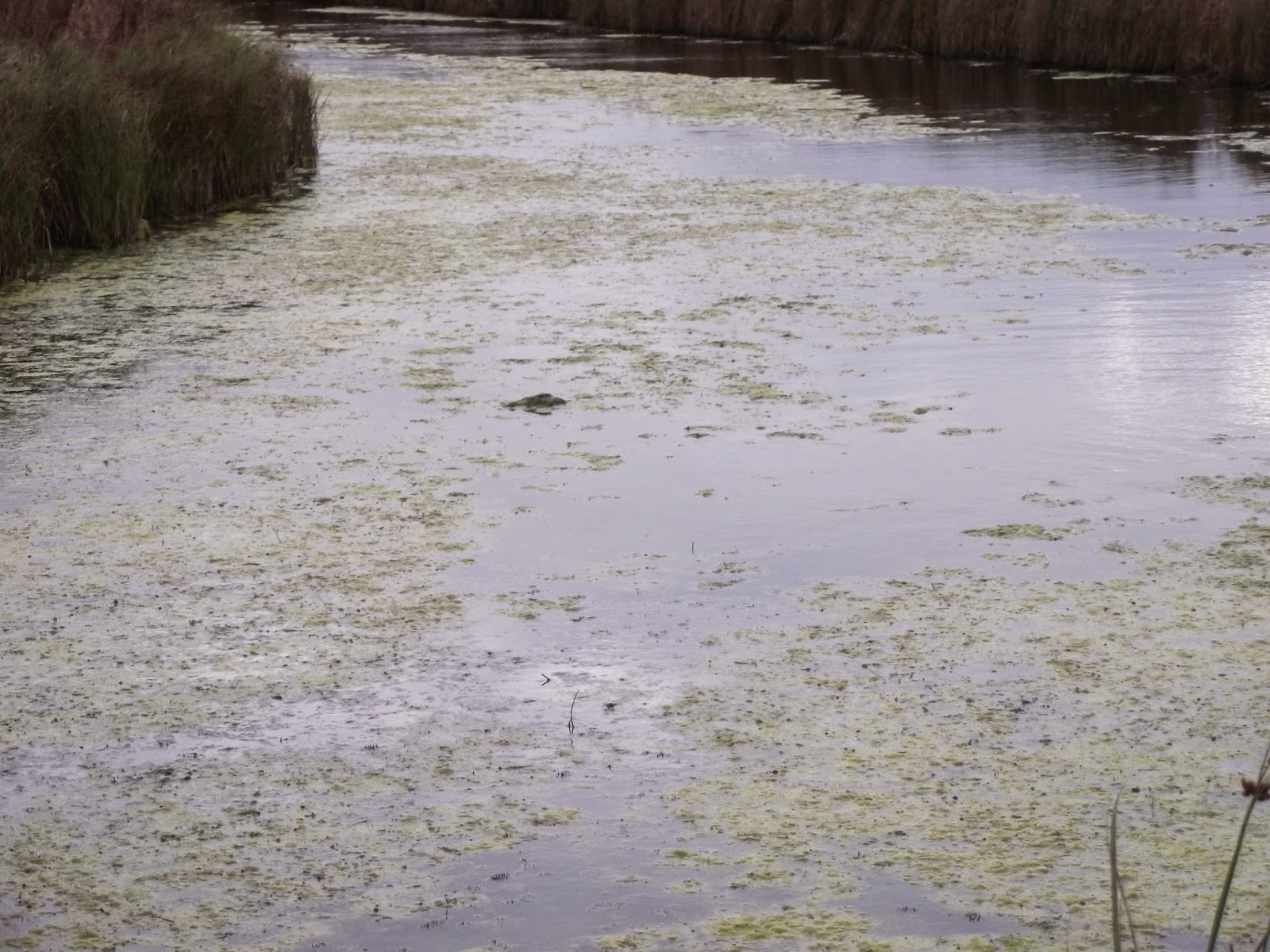
Climbing on top of the sea wall I immediately noticed that the wind was bringing with it the awful stench of the reserve's stagnant ditches and fleets. Virtually no rain for several weeks has seen both the water and oxygen levels in them to drop away quite dramatically and what water that is left in them is either a puce or blue-grey colour. As you can see below, the weed is starting to decompose on the surface and sulphurous bubbles regularly come to the surface.
Whilst I'm always loathe to see the end of guaranteed warm weather, even early mornings this last week or so have been very uncomfortable in very humid and murky conditions and being accompanied by a continuous cloud of hungry mosquitoes all the way round has been intolerable, there was none of that this morning.
Climbing on top of the sea wall I immediately noticed that the wind was bringing with it the awful stench of the reserve's stagnant ditches and fleets. Virtually no rain for several weeks has seen both the water and oxygen levels in them to drop away quite dramatically and what water that is left in them is either a puce or blue-grey colour. As you can see below, the weed is starting to decompose on the surface and sulphurous bubbles regularly come to the surface.
It typifies how the reserve is at the moment, it's very dry and pretty much devoid of bird life, one reason I imagine, that even the wildfowlers have been absent this last week, the Greylags have moved somewhere else and ducks are counted in ones or twos. So many autumns have been like this on the reserve in recent years that it's pretty much become the norm but it makes for some pretty uninspiring walks round, feeling great if you total more than ten of any particular species. Mind you I recall asking for lots of rain this time last year and it really came back to bite me as we had the wettest winter for a hundred years, it's always the same in North Kent, either too dry or too wet.
Early morning on Wednesday saw the first visit this autumn by one of the local hunts and they spent most of the morning working their way round the farmland of Harty looking for foxes. I believe at this time of the year it's called "cubbing", where the young hounds learn from the older ones how to go about fox hunting. Yes, I know that hunting with dogs is banned but that has never bothered the hunts that visit Harty a few times each year and you can hear them actively encouraging the hounds to work through the thickets and reed beds. They are also accompanied by a terrier man on a quad bike, who presumably has the terriers available should any foxes go to ground and need digging out.
Now I'm not going to turn hypocritical and say that I don't agree with killing foxes, because both the NNR's on Sheppey, control foxes throughout the year and I accept that it is a necessary fact of successful reserve management. My only real problem with the hunts is their attitude towards land that they don't have permission to be on, they quite often charge across that without a thought and even get stroppy when challenged. They also, as they did on Wednesday, regularly work the hounds through the whole length of the Capel Fleet reed beds, which have SSSI, SPA and Ramsar status and protection, in order to flush out any foxes, disturbing everything else in the process.
On a far happier note, the Kent Field Club have just published Vol.18 of their regular booklets about various aspects of Kentish flora and Fauna and it is entitled "The Natural History of the Isle of Sheppey". For anybody interested in Sheppey's geology, animals, birds, moths, butterflies, insects, flowers, ditch systems, etc. etc, it is a 270 page booklet packed with colour photographs, maps and numerous chapters written by very knowledgeable people.
It can be bought for £12 + £2 pp by sending a cheque made out to Kent Field Club to Ms. K. Friend, 2, West End Cottages, The Street, Doddington, Kent. ME9 0BZ
Early morning on Wednesday saw the first visit this autumn by one of the local hunts and they spent most of the morning working their way round the farmland of Harty looking for foxes. I believe at this time of the year it's called "cubbing", where the young hounds learn from the older ones how to go about fox hunting. Yes, I know that hunting with dogs is banned but that has never bothered the hunts that visit Harty a few times each year and you can hear them actively encouraging the hounds to work through the thickets and reed beds. They are also accompanied by a terrier man on a quad bike, who presumably has the terriers available should any foxes go to ground and need digging out.
Now I'm not going to turn hypocritical and say that I don't agree with killing foxes, because both the NNR's on Sheppey, control foxes throughout the year and I accept that it is a necessary fact of successful reserve management. My only real problem with the hunts is their attitude towards land that they don't have permission to be on, they quite often charge across that without a thought and even get stroppy when challenged. They also, as they did on Wednesday, regularly work the hounds through the whole length of the Capel Fleet reed beds, which have SSSI, SPA and Ramsar status and protection, in order to flush out any foxes, disturbing everything else in the process.
On a far happier note, the Kent Field Club have just published Vol.18 of their regular booklets about various aspects of Kentish flora and Fauna and it is entitled "The Natural History of the Isle of Sheppey". For anybody interested in Sheppey's geology, animals, birds, moths, butterflies, insects, flowers, ditch systems, etc. etc, it is a 270 page booklet packed with colour photographs, maps and numerous chapters written by very knowledgeable people.
It can be bought for £12 + £2 pp by sending a cheque made out to Kent Field Club to Ms. K. Friend, 2, West End Cottages, The Street, Doddington, Kent. ME9 0BZ
Friday, 12 September 2014
Grass Pollen?
Further to my posting a few weeks ago where I posted a photo of one of my shoes mildly covered in orange dust from the grass on the reserve, well this morning it had increased considerably, as the photos below illustrate. It had even spread onto my trousers.
If indeed it is grass pollen, then it's no wonder that people get hay fever and a probable reason why even my eyes have been sore this year. Can anybody confirm that it is indeed pollen and not simply some kind of dust. Incidentally, my two white terriers, who are at boot height in the grass, always return home as white as they left, why are they not being stained by the dust?
N.B. I have now found out that it is a rust disease of grassland caused by poor growing conditions and the onset of cooler nights.
As for the reserve in general, well it's pretty dire bird wise at the moment as we endure our usual bone dry September conditions and lovely wet Oare is the centre of attention for local bird life. The only real activity on the Swale NNR at the moment is between the wildfowlers and the Greylag geese and Shellness Point, where a few winter birds such as Wigeon and Brent Geese are straggling in.
Monday, 1 September 2014
A New Shooting Season Begins
As is my custom every year, I was on the reserve at 5.15, just as dawn was starting to brighten the eastern sky, to see in the start of the wildfowl shooting season and make my self known and have a chat with, the wildfowlers on the first morning out there.
And what a dawn it was, the sky was split in two, with brightness just showing in the east and stars still out to the west. Gradually however the sky turned to full and blue brightness until, with some speed, a beautiful orange sun rose alongside Shellness and briefly turned the sky a blend of pinks and oranges. It was a perfect September morning.
As I made my way across the marsh towards the sea wall in the half light, shots were already beginning to echo round the farmland with increased regularity, as the dawn light prompted the wildfowl into taking their regular flight lines between roosts and feeding areas. Unless the farmland duck shoots have released Mallard for shooting purposes, ducks are normally at a premium at this time of the year, the main shooting interest is the ever increasing number of Greylag Geese on Harty, especially while they're attracted to the corn stubbles, as below. These photos were taken yesterday on the farmland alongside the reserve and this morning two "duck shooters" were hidden up ready to ambush the geese as they dropped in as normal. Unfortunately for them somebody must of tipped off the geese because not one showed any interest in that particular field today, despite the shooters regularly using their goose call thingy which is supposed to sound like a Greylag Goose but in this case sounded like somebody standing on a cat's tail.
However, despite these two guy's bad luck, that was obviously not the case further out behind them on the marsh. The corn fed ditches and Capel Fleet below Muswell Manor were being heavily shot, something that carried on for an hour or so and at one stage some geese began to circle round and move further inland. Three however, broke away from the flock and as I climbed up on to the sea wall they headed out across the saltings to the tide where the wildfowlers, who had had no shots at all till then, bagged them.
That does tend to be the big difference between the true coastal wildfowlers and the inland "duck shooters", the wildfowlers, as you can see below, tend to prefer a solitary existence out on the saltings, often standing in deep tidal mud and getting the odd shot at what few wildfowl fly out that way.
Not for them the comfort and limited challenge of sitting round corn fed duck ponds and fleets inland, shooting large and unnecessary bags of wildfowl every visit.
When the wildfowlers eventually finished and came back to the sea wall we sat in the warm sunshine of a beautiful morning, listening to curlews and other waders out in the estuary and swapped chat about shooting, conservation and the countryside in general, it was great.
And what a dawn it was, the sky was split in two, with brightness just showing in the east and stars still out to the west. Gradually however the sky turned to full and blue brightness until, with some speed, a beautiful orange sun rose alongside Shellness and briefly turned the sky a blend of pinks and oranges. It was a perfect September morning.
As I made my way across the marsh towards the sea wall in the half light, shots were already beginning to echo round the farmland with increased regularity, as the dawn light prompted the wildfowl into taking their regular flight lines between roosts and feeding areas. Unless the farmland duck shoots have released Mallard for shooting purposes, ducks are normally at a premium at this time of the year, the main shooting interest is the ever increasing number of Greylag Geese on Harty, especially while they're attracted to the corn stubbles, as below. These photos were taken yesterday on the farmland alongside the reserve and this morning two "duck shooters" were hidden up ready to ambush the geese as they dropped in as normal. Unfortunately for them somebody must of tipped off the geese because not one showed any interest in that particular field today, despite the shooters regularly using their goose call thingy which is supposed to sound like a Greylag Goose but in this case sounded like somebody standing on a cat's tail.
However, despite these two guy's bad luck, that was obviously not the case further out behind them on the marsh. The corn fed ditches and Capel Fleet below Muswell Manor were being heavily shot, something that carried on for an hour or so and at one stage some geese began to circle round and move further inland. Three however, broke away from the flock and as I climbed up on to the sea wall they headed out across the saltings to the tide where the wildfowlers, who had had no shots at all till then, bagged them.
That does tend to be the big difference between the true coastal wildfowlers and the inland "duck shooters", the wildfowlers, as you can see below, tend to prefer a solitary existence out on the saltings, often standing in deep tidal mud and getting the odd shot at what few wildfowl fly out that way.
Not for them the comfort and limited challenge of sitting round corn fed duck ponds and fleets inland, shooting large and unnecessary bags of wildfowl every visit.
When the wildfowlers eventually finished and came back to the sea wall we sat in the warm sunshine of a beautiful morning, listening to curlews and other waders out in the estuary and swapped chat about shooting, conservation and the countryside in general, it was great.
Friday, 15 August 2014
Ploughing returns
There's a surprising change to the regular farming methods taking place on parts of Harty at the moment, it's called ploughing, yes, good old-fashioned deep ploughing. Talking to the farmer responsible it's all due to a weed called Black Grass that is spreading pretty much unchecked through arable crops in this country due to it's resistance to current weedkillers.
I rather suspect that modern arable cultivation methods must have helped in the successful spread of this weed as well. 80% of the plants of this weed emerge between August and October and the plants emerge from seed within 5cm of the surface. These days farmers rarely plough their arable fields, they simply scratch over the surface immediately after the crops are harvested and then re-sow for the following year. In this way they are creating perfect conditions for the Black Grass and other weeds to emerge and grow on during the winter.
So, as a last resort, the farmer has turned to old-fashioned ploughing in the hope that he will bury the weed seeds deep enough so that they will fail to germinate and at the same time he will break up the hard surface crust of the soil and improve drainage and aeration - clever people those old time farmers, they knew what they were doing!
Below, I came across this clump of recently hatched Peacock butterfly caterpillars this morning, I've not seen them this late before.
For a few weeks now, most times when I leave the reserve my boots are covered in a fine orange dust, sometimes much thicker than this - it's grass pollen. No wonder my terriers, who are down at grass level, spend the first few hours back home sneezing and snuffling.
Is it just me, but it seems as if we are already in autumn. The weather already has a cooler autumn feel, sloes are ripening fast and the first mushrooms are beginning to appear on the marsh.
On a different note, the sea wall hide is beginning to collect people's unwanted rubbish. Why they feel that we should clear up after them I don't know.
I rather suspect that modern arable cultivation methods must have helped in the successful spread of this weed as well. 80% of the plants of this weed emerge between August and October and the plants emerge from seed within 5cm of the surface. These days farmers rarely plough their arable fields, they simply scratch over the surface immediately after the crops are harvested and then re-sow for the following year. In this way they are creating perfect conditions for the Black Grass and other weeds to emerge and grow on during the winter.
So, as a last resort, the farmer has turned to old-fashioned ploughing in the hope that he will bury the weed seeds deep enough so that they will fail to germinate and at the same time he will break up the hard surface crust of the soil and improve drainage and aeration - clever people those old time farmers, they knew what they were doing!
Below, I came across this clump of recently hatched Peacock butterfly caterpillars this morning, I've not seen them this late before.
For a few weeks now, most times when I leave the reserve my boots are covered in a fine orange dust, sometimes much thicker than this - it's grass pollen. No wonder my terriers, who are down at grass level, spend the first few hours back home sneezing and snuffling.
Is it just me, but it seems as if we are already in autumn. The weather already has a cooler autumn feel, sloes are ripening fast and the first mushrooms are beginning to appear on the marsh.
On a different note, the sea wall hide is beginning to collect people's unwanted rubbish. Why they feel that we should clear up after them I don't know.
Wednesday, 13 August 2014
Catching Rabbits
I continue to be exasperated at Countryfile's weekly portrayal of the British Countryside - why, we must have a whole generation of youngsters now that have been "educated" about the countryside by watching that programme. A whole generation that haven't been made aware of so many things that occur out there such as fishing, shooting, hunting, pest controls, ferreting, ditch cleaning, sea wall repairing, building hay stacks, etc, etc. The fairy tale version of the countryside that the BBC present is nothing like the one that I experience on my daily visits and merely seems to pander to local bloggers here that refer to shooters as halfwits and who complain about people who shout and whistle at their dogs in the countryside. Can you imagine - "why is that nasty shepherd whistling and shouting at his sheepdog, can't he do it quietly to round up the sheep!"
Anyway, below is a glimpse of real and normal life in the countryside.
I first learnt about, and participated in, the catching of rabbits when I joined the Kent River Authority's Sheppey work gang in 1966, aged 19. The core of the gang was only around six or seven strong but added to from time to time by others, who rarely stayed longer than the summer once the archaic outside work conditions that we suffered through the winter took hold.
For me, as someone who had always been interested in wildlife and the countryside since a child, it was a real joy to be working in the more remote parts of the Sheppey countryside, places that I didn't know existed and were often inaccessible to the public. To experience these places throughout the seasons and among people of a similar age but who already had practical experience of countryside ways and skills, made going to work each day a real delight.
Foremost among the gang was one of the Gransden family, who had been farming on Elmley for over thirty years and he was therefore well versed in hunting and shooting skills. Another guy spent all his spare time helping the local shoot and when he left the KRA after a couple of years, spent the rest of his life as a gamekeeper. Another, who became a good friend, did quite a bit of shooting and the odd bit of poaching around Sheppey and lastly, one who stayed on the KRA all his working life. That particular guy is still one of my best friends and is probably Sheppey's last true countryman in the Jack Hargreaves mould and is still practising his skills in all weathers in his 70's.
So I quickly settled in to the groove with these guys and began to absorb all manner of knowledge about countryside ways, combined of course, with the long established but now out-dated skills used in sea wall and ditch management. Skills such as hand scything ditch banks, repairing groynes along beaches and the art of chipping and shaping rocks and then laying them as a level surface on the sides of sea walls to prevent erosion from the sea. But in the winter especially, we would often use our lunch breaks and later, weekends, to wander out into the marsh wherever we were and catch and kill rabbits., rabbits will sit out
In areas of rough grassland, individual rabbits will conceal themselves in what we used to call "seats", a rabbit sized depression in a clump of grass and usually the only time that you knew that they were there was when they suddenly bolted out of it. However I quickly learnt by walking across the marsh with these guys, that you become adept at just "knowing" which grass clump contained a rabbit in it's "seat". It might be just the particular shape of the clump or you might actually see an eye blink inside it, but the rabbit would sit tight and hope that you would simply walk past, not noticing it. However, if you had spotted it, the art was to not break your stride and suggest it had been seen but as you walked by, to suddenly strike it with the weighted stick that you was carrying or, in a really quick and skillful movement, suddenly throw out a leg and stand on it. In this way many a lunch break saw us providing a weekend roast rabbit for ourselves or others, especially once I'd honed the relatively easy art of cleaning and skinning a rabbit down to just a couple of minutes. A few years later in the early 1970's, when most of us had moved on to other jobs, four of us still met on a Sunday morning to spend a couple of hours walking in line abreast across a marsh, catching rabbits in that way and Spitend marsh at Elmley was our usual spot. Spitend in those pre-RSPB days was an ideal spot, a huge acreage of rough, poorly grazed marsh, absolutely teeming with rabbits and we had unrestricted access.
However, as other things in life became more important, the group split up and it was left to just two of us to maintain the rabbiting weekends at Spitend and we set about changing our catching methods. The obvious one was ferreting, which we sometimes carried out but it had drawbacks such as having to keep ferrets throughout the year, which neither of us fancied, especially as I hated handling the bloody things and losing them inside the rabbit warrens. So we devised and stuck with the method that we used for several years after, which involved utilising our Jack Russell terriers, spades and lots of hard work.
Basically, as we wandered around the Spitend marsh and nearby Windmill Creek saltings, the dogs would quickly indicate to us which of the countless rabbit holes had someone at home by digging furiously at them. We would then begin digging at the holes ourselves with the spades, following the direction that the tunnels were taking and often competing with the digging dogs at the same time. Sometimes the tunnels would take a deep direction but generally we found that they usually maintained a depth of a foot or two below the surface and could run for just a couple of yards or several yards. After every few spadefuls of soil we would then lay on the ground and extend an arm along the tunnel to see if we could feel the rabbit and once we did it would be pulled out and immediately dispatched. Below you can see both myself and my two dogs after one such successful dig.
It was easily the most strenuous and dirty way of catching rabbits that I have ever undertaken as you can see below but we thoroughly enjoyed it and we would usually reckon on catching a dozen or two at each visit and how wonderful to be out in such beautiful countryside.
It was while returning from one of these Spitend days in around 1975 that we eventually bumped in to the newly arrived RSPB manager Peter Makepeace who advised us that Spitend was about to be turned into a bird reserve. He not only encouraged us to continue with our rabbiting due to the fact that they could be counted in their thousands but would sometimes find the time to spend a Sunday with us and help carry the rabbits back.
Below I am once again pictured at the end of a successful Sunday, with nothing left but to take the rabbits to the local Workingman's Club and swap them for a few welcome pints of beer.
Anyway, below is a glimpse of real and normal life in the countryside.
I first learnt about, and participated in, the catching of rabbits when I joined the Kent River Authority's Sheppey work gang in 1966, aged 19. The core of the gang was only around six or seven strong but added to from time to time by others, who rarely stayed longer than the summer once the archaic outside work conditions that we suffered through the winter took hold.
For me, as someone who had always been interested in wildlife and the countryside since a child, it was a real joy to be working in the more remote parts of the Sheppey countryside, places that I didn't know existed and were often inaccessible to the public. To experience these places throughout the seasons and among people of a similar age but who already had practical experience of countryside ways and skills, made going to work each day a real delight.
Foremost among the gang was one of the Gransden family, who had been farming on Elmley for over thirty years and he was therefore well versed in hunting and shooting skills. Another guy spent all his spare time helping the local shoot and when he left the KRA after a couple of years, spent the rest of his life as a gamekeeper. Another, who became a good friend, did quite a bit of shooting and the odd bit of poaching around Sheppey and lastly, one who stayed on the KRA all his working life. That particular guy is still one of my best friends and is probably Sheppey's last true countryman in the Jack Hargreaves mould and is still practising his skills in all weathers in his 70's.
So I quickly settled in to the groove with these guys and began to absorb all manner of knowledge about countryside ways, combined of course, with the long established but now out-dated skills used in sea wall and ditch management. Skills such as hand scything ditch banks, repairing groynes along beaches and the art of chipping and shaping rocks and then laying them as a level surface on the sides of sea walls to prevent erosion from the sea. But in the winter especially, we would often use our lunch breaks and later, weekends, to wander out into the marsh wherever we were and catch and kill rabbits., rabbits will sit out
In areas of rough grassland, individual rabbits will conceal themselves in what we used to call "seats", a rabbit sized depression in a clump of grass and usually the only time that you knew that they were there was when they suddenly bolted out of it. However I quickly learnt by walking across the marsh with these guys, that you become adept at just "knowing" which grass clump contained a rabbit in it's "seat". It might be just the particular shape of the clump or you might actually see an eye blink inside it, but the rabbit would sit tight and hope that you would simply walk past, not noticing it. However, if you had spotted it, the art was to not break your stride and suggest it had been seen but as you walked by, to suddenly strike it with the weighted stick that you was carrying or, in a really quick and skillful movement, suddenly throw out a leg and stand on it. In this way many a lunch break saw us providing a weekend roast rabbit for ourselves or others, especially once I'd honed the relatively easy art of cleaning and skinning a rabbit down to just a couple of minutes. A few years later in the early 1970's, when most of us had moved on to other jobs, four of us still met on a Sunday morning to spend a couple of hours walking in line abreast across a marsh, catching rabbits in that way and Spitend marsh at Elmley was our usual spot. Spitend in those pre-RSPB days was an ideal spot, a huge acreage of rough, poorly grazed marsh, absolutely teeming with rabbits and we had unrestricted access.
However, as other things in life became more important, the group split up and it was left to just two of us to maintain the rabbiting weekends at Spitend and we set about changing our catching methods. The obvious one was ferreting, which we sometimes carried out but it had drawbacks such as having to keep ferrets throughout the year, which neither of us fancied, especially as I hated handling the bloody things and losing them inside the rabbit warrens. So we devised and stuck with the method that we used for several years after, which involved utilising our Jack Russell terriers, spades and lots of hard work.
Basically, as we wandered around the Spitend marsh and nearby Windmill Creek saltings, the dogs would quickly indicate to us which of the countless rabbit holes had someone at home by digging furiously at them. We would then begin digging at the holes ourselves with the spades, following the direction that the tunnels were taking and often competing with the digging dogs at the same time. Sometimes the tunnels would take a deep direction but generally we found that they usually maintained a depth of a foot or two below the surface and could run for just a couple of yards or several yards. After every few spadefuls of soil we would then lay on the ground and extend an arm along the tunnel to see if we could feel the rabbit and once we did it would be pulled out and immediately dispatched. Below you can see both myself and my two dogs after one such successful dig.
It was easily the most strenuous and dirty way of catching rabbits that I have ever undertaken as you can see below but we thoroughly enjoyed it and we would usually reckon on catching a dozen or two at each visit and how wonderful to be out in such beautiful countryside.
It was while returning from one of these Spitend days in around 1975 that we eventually bumped in to the newly arrived RSPB manager Peter Makepeace who advised us that Spitend was about to be turned into a bird reserve. He not only encouraged us to continue with our rabbiting due to the fact that they could be counted in their thousands but would sometimes find the time to spend a Sunday with us and help carry the rabbits back.
Below I am once again pictured at the end of a successful Sunday, with nothing left but to take the rabbits to the local Workingman's Club and swap them for a few welcome pints of beer.
Saturday, 2 August 2014
A Fishy Tale
Late 1970's and early autumn and my friend and I were at the Kingsferry Bridge at dusk, about to launch our boat down the ramp and into the fast ebbing Swale. It was the latest of our twice weekly forays down the Swale to check and empty our eel fyke nets, set in the fleets on Chetney marsh, directly opposite Rushenden on Sheppey. We had asked permission from the landowner to net the fleets and been refused, so nothing for it but to go after dark and it had been a productive couple of weeks with good catches of eels.
"Looks a bit misty" I said to my friend as we pushed the boat out into the tide and started the small outboard motor, "it'll be alright" he replied - famous last words!
The boat was little more than a large dingy with a tiny wheelhouse but it served the purpose of our short, after dark forays just right, just enough room for us and our large keep net and an old bread basket to carry the catch back in. A mile or so down the Swale we turned the boat towards the Chetney shore and run it on to the now exposed mud banks, securing it with a rope and anchor. Startled Redshanks and Oystercatchers noisily took off and disappeared into the increasing darkness as we disturbed their feeding place and only the distant lights of the Grain oil refinery across the estuary gave us a bit of help to see, although they were worryingly becoming less obvious as the mist increased. It was then, chest waders on and over the side into the gloopy mud and dark, carrying the bread basket and net between us. It was only about fifty yards to the base of the seawall but the deep and clinging mud made it very hard work but we soon got there and looked back at our footprint trail to the boat, how we'd be glad of that later on.
We swiftly waddled over the sea wall, because that's what you do in chest waders, you waddle with your legs apart, rather than actually walk properly, and then the fleet that we were netting was directly in front of us. There are two ways of fyke netting a fleet or ditch, you can row down it in a dingy, laying out the nets in a continuous line down the middle, or stake them across the fleet from bank to bank - we were obviously doing the latter. The nets themselves are about 15-20ft long and two thirds consists of a length of two foot high net attached to a series of ringed holding compartments, as you can see above. It would be stretched across a fleet or ditch, resting on the bottom and staked at each end to keep it taunt. As we were basically poaching the eels the stakes had to be pushed out of sight under the water and discreet markers left on the bank side to indicate to us where they were. Generally we would mark the first net and then set the rest at paced out thirty yard intervals. As eels travel down the ditch the lead nets would hold them up and guide them towards the trapping end where non-return netting would prevent them from escaping again.
The only problem with that method sometimes was the fact that it needed one of us on either side of the fleet/ditch and sometimes you had to walk long distances before finding a crossing point to enable you to get on the other bank. So there we were, in the middle of a dark evening with just a torch to help us and with the mist rapidly rushing across the marsh towards us, sleeves rolled up and feeling under the water for those first two stakes. I had the keep net and the trap end of the nets that night and so having finally located the stake and net, lifted it out of the water, terrific, several pound of wriggling eels in there. My friend on the other side tied a rope to his end and I pulled the net part of the way towards me in order to untie and empty the trapping end into the keep net. It was then a simple matter of pulling the fyke net back taunt across the fleet and re-staking it at each end, one wet arm and shoulder of my sweater, the first lot of eels and several nets yet to empty. An hour or so later and ten o'clock at night, we were finally back on the top of the sea wall, wet and rather smelly from ditch mud and eel slime but carrying a good poundage of live eels between us in the bread basket. There was just one major problem, while we had been busy the mist had become thick fog and we could see no further than a few yards in front of us and definitely not the boat out on the edge of the tide somewhere. However we managed to find the end of the footprint trail we'd left in the mud and with much effort, carrying a heavy basket between us, re-traced our footsteps until the boat re-appeared in the gloom. Finally sitting back aboard, out of breath and sweating, it was decision time - how the hell do we find our way back to the Kingsferry Bridge in fog that thick!
Easy we thought, if we're standing with our backs to Chetney, Sheppey is opposite and therefore the Bridge is right of us down channel, let's push off and head in that direction, stupidity indeed! Within minutes of pushing out into the fog and drifting round as we started the outboard motor, we had lost sight of the Chetney mudflat and therefore all sense of direction, we were sitting in the middle of the Swale in a really dense fog and lost, great, it could be a long and scary night. We switched off the motor and drifted for a little while and then got the oars out and rowed in no particular direction, slight panic setting in, being lost in fog can be so dis-orientating. But then I suddenly smelt sewerage, yes definitely sewerage - it was one of those eureka moments such as Mole and Ratty had in the Wind in the Willows, when lost in the Wild Wood in thick snow they suddenly stumbled on the foot scraper outside the entrance to the Badger's home.
" Yes, so what's so special about smelling sewerage", my friend said. "Think about it" I said, "where's the only sewerage outfall along here, the Rushenden one on the Sheppey side, head towards it". So we did, rowing slowly with much sniffing of the air, and eventually came against mudflats with the smell in front of us. "Well at least we know where we are" my friend said, "and safe from harm". "Yes" said I, "and I'm not going to sit here all night with my wife panicking when I don't return by midnight", (we had no mobile phones in those days), " so here's what I suggest, " clearly if we face the shore then the Bridge is a mile or so away to our right. If we head in that direction, making sure that we don't lose sight of the mudflats, then we should eventually end up at the bridge and the slipway." A great idea but with visibility down to a few yards we couldn't get in to water deep enough to use the outboard motor and with only one oar usable due to the mud being on one side, there was only one option becoming unfavourably clear, we would have to get and pull the bloody boat by it's anchor rope and that's what we did. I can still feel the pain and sweat now of pulling the boat along the water's edge while walking in soft and clinging mud in chest waders, it was excruciating and very few gym work-outs could compete with it.
Some time later, as our lungs felt like they were going to burst and legs were like jelly, we suddenly heard the sound of traffic passing across the invisible Bridge, we were almost there! Eventually when almost under the Bridge it's lights shone enough to guide us across the Swale and locate the slipway, it was past midnight but we'd made it, joy. A little later, after tipping the eels in to the holding tank in my garden, I fell in to bed, no doubt stinking of tidal mud and eel slime, mumbled "don't ask" to my wife and slept the few hours left before I was due to be at work.
We carried out those eel trapping expeditions for around ten years through the summer months, normally on Sheppey and often after dark where we shouldn't be, but that was easily the most scary of our trips.
Subscribe to:
Posts (Atom)