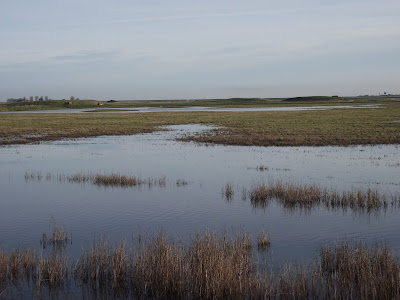
Walking across a part-flooded reserve early this morning was hard work. Negotiating the flooded parts wasn't too bad, it was the gale force wind and bouts of horizontal drizzle that made it worse. Plus it means that I have to wear wellies and I never find them comfortable at the best of times. Large areas of foot deep water are not exactly the kind of conditions that I imagine Ellie, my little Jack Russell, finds enjoyable either, but she gamely runs or swims her way through it all.
I haven't been across to the sea wall for several days, simply in order to avoid having to cross the wet marsh, but today was the last day of the current wildfowling season. The wildfowlers put their guns away until September 1st, when it all starts again. As the reserve's Voluntary Warden and the only person the wildfowlers are likely to encounter from it's management, I always like to keep on friendly terms with them and have an end of season chat. Standing on the sea wall being buffeted by the wind and rain, it was surprising just how many wildfowl have returned, now, over the last couple of weeks, that we finally have the wet conditions that they so love.
It was an irony not lost on the wildfowlers as we chatted - all those wildfowl now that the shooting season has ended - a sod's law sort of event, which is not unusual in their pursuit. This morning, between the four of them, they had shot just the one duck, which was a pretty poor return for standing in deep, tidal mud and the wind and rain for several hours. We stood there comparing notes on how the two different types of season have gone for us all and it seemed a very long time ago since they sat out there with their guns on very warm and sunny September evenings, being bitten to death by mosquitoes.
But now they have finished for six months and apart from the odd birdwatcher or walker, I will have the place to myself again. Time to dream about sitting on the same sea wall on hot, sunny mornings, watching Ellie trying to catch voles in the long grass and being lulled into a lazy frame of mind by the drone of bees and the silent passage of butterflies - ah my kind of season.
Thursday, 20 February 2020


Sunday, 16 February 2020
Same Again
Well, almost a month has gone by since my last post and that post's title could just as easily apply to this one. There are a few subtle differences, the water levels have continued to increase in both depth and area and at last, duck numbers are also beginning to increase. Mallard, Teal, Pintail, Gadwall and Shoveler are all beginning to re-appear and combined with large numbers of Greylag, White-fronted and Brent Geese, it's all starting to look how it should do at this time of the year.

The photo below indicates the kind of access problems that we are now experiencing as a result of the rising water levels. The main track through the reserve runs through this gate and turns towards where I was standing on a raised bund. The ditch either side of the gate and track has flooded across them both and this is being repeated in many places around the reserve. It means that access/viewing, is pretty much limited to the boundary route at the rear of the reserve and the sea wall that you can see in the background distance. They say that you should be careful what you wish for and after four years of asking for decent rainfall to alleviate the reserve's dryness, we've now got a tad too much.


The photo below indicates the kind of access problems that we are now experiencing as a result of the rising water levels. The main track through the reserve runs through this gate and turns towards where I was standing on a raised bund. The ditch either side of the gate and track has flooded across them both and this is being repeated in many places around the reserve. It means that access/viewing, is pretty much limited to the boundary route at the rear of the reserve and the sea wall that you can see in the background distance. They say that you should be careful what you wish for and after four years of asking for decent rainfall to alleviate the reserve's dryness, we've now got a tad too much.

The other notable feature of this February so far, is the lack of any mild and sunny days, it been mostly cold, wet and windy, especially so during the two major storms, Ciara and now Dennis which we are enduring as I write this. Dennis is forecast to possibly dump a month's worth of rain today, so even wetter conditions will exist by tomorrow.
I have found it all so very depressing and cannot wait for us to climb out of this dark dampness and to feel a warm sun on my face.
Tuesday, 28 January 2020
Mud, Water and Winter
"I leant upon a coppice gate
When frost was spectre-gray
And Winter's dregs made desolate
the weakening eye of day"...............Thomas Hardy
The title pretty sums up this last month. So many days have been so grey, gloomy, rainy, windy and cold, that it's been a real challenge to walk round the reserve at times. I'm not a great lover of wearing wellie boots but so wet and muddy are parts of the reserve, that their wearing has been a necessary requisite in order to navigate some parts. No such comfort for my little Jack Russell, Ellie, she has spent a lot of her time swimming through flooded ditches or across lakes of flood water but she takes it all in her stride.
This month also saw us rid of the cattle herd, finally taken away to pens in the grazier's farm yard. They were left on the reserve far longer than the wet conditions allowed and now we have been left with a number of earth crossing points across ditches, that are almost non-traversable on foot due to the depth of the quagmire of mud churned up by their feet. They have now been replaced, for a couple of months, by a number of sheep. As well as being less damaging to the ground, their purpose is to graze the grass down to a very short sward and leave several of the fields perfect for Lapwing breeding this Spring.
But apart from the discomfort and pain of getting around the reserve on foot, it has quite clearly, looked better for wildfowl and waders than it has for the last 4-5 years. Frustratingly, however, we haven't seen a rapid rise in the numbers of either this winter so far. The flock of wintering White-fronted Geese rose to a maximum of 121 birds before they moved into the nearby Harty marshes and continuing to increase in numbers there. That left just the large flock of resident Greylag Geese and sometimes, odd Barnacle, Pink-footed and Tundra Bean Geese. As for ducks, well the days of flocks totalling hundreds, if not thousands, seem well behind us now and we're still only counting them in tens and twenties. My weekly chats with the wildfowlers on the sea wall only finds myself and them swapping the same frustrations - where are all the birds these days? They've had a lot of really cold and gloomy days hunkered down out on the saltings, waiting for wildfowl to shoot, just for nil returns.
It's been a pretty poor month all round and to be honest, I haven't enjoyed several of the visits but hey-ho, just the four weeks of February to endure and things will hopefully, slowly begin to improve - to much cold and wet does not do my old bones any good at all.
When frost was spectre-gray
And Winter's dregs made desolate
the weakening eye of day"...............Thomas Hardy
The title pretty sums up this last month. So many days have been so grey, gloomy, rainy, windy and cold, that it's been a real challenge to walk round the reserve at times. I'm not a great lover of wearing wellie boots but so wet and muddy are parts of the reserve, that their wearing has been a necessary requisite in order to navigate some parts. No such comfort for my little Jack Russell, Ellie, she has spent a lot of her time swimming through flooded ditches or across lakes of flood water but she takes it all in her stride.
This month also saw us rid of the cattle herd, finally taken away to pens in the grazier's farm yard. They were left on the reserve far longer than the wet conditions allowed and now we have been left with a number of earth crossing points across ditches, that are almost non-traversable on foot due to the depth of the quagmire of mud churned up by their feet. They have now been replaced, for a couple of months, by a number of sheep. As well as being less damaging to the ground, their purpose is to graze the grass down to a very short sward and leave several of the fields perfect for Lapwing breeding this Spring.
But apart from the discomfort and pain of getting around the reserve on foot, it has quite clearly, looked better for wildfowl and waders than it has for the last 4-5 years. Frustratingly, however, we haven't seen a rapid rise in the numbers of either this winter so far. The flock of wintering White-fronted Geese rose to a maximum of 121 birds before they moved into the nearby Harty marshes and continuing to increase in numbers there. That left just the large flock of resident Greylag Geese and sometimes, odd Barnacle, Pink-footed and Tundra Bean Geese. As for ducks, well the days of flocks totalling hundreds, if not thousands, seem well behind us now and we're still only counting them in tens and twenties. My weekly chats with the wildfowlers on the sea wall only finds myself and them swapping the same frustrations - where are all the birds these days? They've had a lot of really cold and gloomy days hunkered down out on the saltings, waiting for wildfowl to shoot, just for nil returns.
It's been a pretty poor month all round and to be honest, I haven't enjoyed several of the visits but hey-ho, just the four weeks of February to endure and things will hopefully, slowly begin to improve - to much cold and wet does not do my old bones any good at all.
Tuesday, 31 December 2019
Midsummer Dreams
So here we are, New Year's Eve, a dull, misty and very damp day, one to easily forget. The excesses and once a year fakery of being religious for a few days are now almost behind us and already we are ten days past the Shortest Day. Tonight we step over the threshold into not only a new year but a new decade. It'll still be several weeks before the days lengthen enough for us countryside and wildlife lovers to begin to get excited about a new Spring but I console myself with dreams of one of my favourite times of the year - Midsummer.
At that time of the year it's quite usual for me to rise, after a sleepless and hot night, at around 4.30 and set off with my dog to the nature reserve on the marsh. There, in the brief freshness at the start of another long hot day, is a wondrous place. The first thing to greet me as I step onto the marsh is a great avian chorus - the geese the backing group, the Skylarks the lead singers and the Curlews the bubbling orchestra in the background.
As I begin to walk round, there will be faint wisps of mist rising from the surface of the ditches and fleets and I will be surrounded by the business of parent birds as they rush to feed offspring before the heat of the day starts to take effect. Coots will be "tucking" at their chicks, shushing them into the cover of the reed stems to hide from me. In the reed beds themselves, dozens of Reed Warblers will be constantly uttering their song, which is little more than the same couple of notes monotonously repeated over and over. Then there are the Marsh Frogs, noisy as hell as their loud croaking spreads like a bushfire throughout the whole marsh, to suddenly stop in an instant as some threat or other appears in their vision.
On the clumps of Ragwort large clusters of the stripey yellow and black Cinnabar Moth caterpillars feed hungrily on the leaves while assorted butterflies feed from the yellow flowers. Moving across the longer grass of the grazing meadows, where the skylarks continue to serenade me from far above, there are the butterflies. Meadow Browns, Small Heaths, Small Skippers, lazy in flight and giving a peacefulness to the avian frenzy all around. It's a lot to take in and enjoy but soon, as the heat begins to build again, it's time to head back home again and the rigours of the day.
In the evening, as the first zephyrs of cooling air begin to peck away at the lingering heat, it's time to sit in the garden and mull over the events of the long, hot summer's day. Small parties of Swifts will circle,high overhead, screaming down at me as they feed on rising insects. Then, as dusk begins to lessen the light, bats begin to appear. They circle my garden like large dark moths, happily feeding on the mosquitoes above my garden pond. Soon it is gone 10.00 and only in the western sky is there the last lingering brightness in the sky as the the day tries hard not to die, but it's time to draw a curtain on it all and go to bed, a midsummer's day to dream about.
At that time of the year it's quite usual for me to rise, after a sleepless and hot night, at around 4.30 and set off with my dog to the nature reserve on the marsh. There, in the brief freshness at the start of another long hot day, is a wondrous place. The first thing to greet me as I step onto the marsh is a great avian chorus - the geese the backing group, the Skylarks the lead singers and the Curlews the bubbling orchestra in the background.
As I begin to walk round, there will be faint wisps of mist rising from the surface of the ditches and fleets and I will be surrounded by the business of parent birds as they rush to feed offspring before the heat of the day starts to take effect. Coots will be "tucking" at their chicks, shushing them into the cover of the reed stems to hide from me. In the reed beds themselves, dozens of Reed Warblers will be constantly uttering their song, which is little more than the same couple of notes monotonously repeated over and over. Then there are the Marsh Frogs, noisy as hell as their loud croaking spreads like a bushfire throughout the whole marsh, to suddenly stop in an instant as some threat or other appears in their vision.
On the clumps of Ragwort large clusters of the stripey yellow and black Cinnabar Moth caterpillars feed hungrily on the leaves while assorted butterflies feed from the yellow flowers. Moving across the longer grass of the grazing meadows, where the skylarks continue to serenade me from far above, there are the butterflies. Meadow Browns, Small Heaths, Small Skippers, lazy in flight and giving a peacefulness to the avian frenzy all around. It's a lot to take in and enjoy but soon, as the heat begins to build again, it's time to head back home again and the rigours of the day.
In the evening, as the first zephyrs of cooling air begin to peck away at the lingering heat, it's time to sit in the garden and mull over the events of the long, hot summer's day. Small parties of Swifts will circle,high overhead, screaming down at me as they feed on rising insects. Then, as dusk begins to lessen the light, bats begin to appear. They circle my garden like large dark moths, happily feeding on the mosquitoes above my garden pond. Soon it is gone 10.00 and only in the western sky is there the last lingering brightness in the sky as the the day tries hard not to die, but it's time to draw a curtain on it all and go to bed, a midsummer's day to dream about.
Monday, 23 December 2019
Sunshine came softly
"Sunshine came softly,
through my window today" ........Donovan
At last, I actually got up early this morning to dry roads and clear skies, in other words, no rain! Eventually those clear skies became blue skies, filled with sunshine and no clouds - after several days of trudging round the reserve in mud and deep water, in rain and wind, the sunshine made it seem so much more bearable.
Despite all the rain that has fell, the reserve still isn't as flooded as I've seen it in past years, more a case of ditches and fleets full up and overflowing and waterlogged grazing fields. Two weeks ago the ditch below was three feet lower than it is now.

The one below was a simple ditch last week, now turned into a fleet.

Two examples below of how the reed bed fleets have filled up and spread out, just need the ducks now.


After spending two hours on the reserve wading through or swimming the wet conditions, Ellie laughs in the face of dogs that wear coats, she's fit and tough.

through my window today" ........Donovan
At last, I actually got up early this morning to dry roads and clear skies, in other words, no rain! Eventually those clear skies became blue skies, filled with sunshine and no clouds - after several days of trudging round the reserve in mud and deep water, in rain and wind, the sunshine made it seem so much more bearable.
Despite all the rain that has fell, the reserve still isn't as flooded as I've seen it in past years, more a case of ditches and fleets full up and overflowing and waterlogged grazing fields. Two weeks ago the ditch below was three feet lower than it is now.

The one below was a simple ditch last week, now turned into a fleet.

Two examples below of how the reed bed fleets have filled up and spread out, just need the ducks now.


After spending two hours on the reserve wading through or swimming the wet conditions, Ellie laughs in the face of dogs that wear coats, she's fit and tough.

The White-fronted Geese numbers continue to creep up on a daily basis, yesterday there were 74 and this morning 81, which seems odd. Normally we would expect them to arrive as cold weather pushes them across from Holland, etc. but our winds are currently from the south or south west.
With sunshine forecast for tomorrow and Christmas Day it will be great wandering round the reserve for the next few days, brightening up the one week of the year that I hate the most. If I hear one more person say that people should never be on their own at Christmas, I will scream. Some of us do actually enjoy missing all that Christmas crap, roll on the New Year!
Tuesday, 17 December 2019
A Wet Winter
Well, after several dry winters the tide has finally turned, or at least the weather has. It's been a fairly wet couple of months up till now and finally, over the last week or so, it has been noticeable that many of the ditches on the reserve are close to normal winter levels. We still haven't got large wet splashes of water across the grazing marsh, the type that attract the wading birds and wildfowl in large numbers, but I have a feeling that that is about to change.
As I write this we're just coming to the end of 14 hours of continuous unbroken rain, water is pouring down the roads and out of every drive and garden around here, it is bloody wet!
When it does eventually stop I'll go down to the reserve and see what a difference this last lengthy session has made but it'll be over the next week that changes will really start to show. The reserve is lower than the arable farmland alongside it and therefore all that rainfall on the farmland will gradually drain into our boundary ditches. They in turn will then over-top and spread out into the grazing marsh and quickly produce the conditions we have been missing for the last 4-5 years.
That all sounds perfect, my moans about dry winters will be at end, but it then creates a new moan, daily walking round in part flooded and very muddy conditions is bloody hard and tiring work, especially when you have arthritic joints as I do, but you won't see me stop.
Apart from that, wildfowl and wader numbers on the grazing marsh part of the reserve have continued to be low so far, except for the geese. They have remained fairly constant over the last few weeks. Yesterday, when our team carried out this month's Wetland Bird Survey (WEBS) on the reserve, part of my count produced 220 Greylag Geese, 41 White-fronted Geese and 1 Tundra Bean Goose on the reserve and 600 Brent Geese feeding on the winter corn alongside the reserve. There were also 5 Pink-footed Geese for a few weeks but they appear have transferred to nearby Harty marshes for the moment. Apart from the Greylag Geese, the other geese species are truly wild geese that winter in the UK from the far north of Europe. The Greylags are semi-feral, here all year round, breed throughout much of the South in large numbers and despite regular attention from the local wildfowlers and duck shooters, never seem to diminish in numbers.
Lastly, joy of joys, this Sunday sees the Shortest Day - nothing will change much in day lengths for another month, but it'll kind of feel like it is and that's good enough. So, hopefully my next blog posting will contain photos of a part flooded reserve and perhaps news of an increase in bird numbers.
As I write this we're just coming to the end of 14 hours of continuous unbroken rain, water is pouring down the roads and out of every drive and garden around here, it is bloody wet!
When it does eventually stop I'll go down to the reserve and see what a difference this last lengthy session has made but it'll be over the next week that changes will really start to show. The reserve is lower than the arable farmland alongside it and therefore all that rainfall on the farmland will gradually drain into our boundary ditches. They in turn will then over-top and spread out into the grazing marsh and quickly produce the conditions we have been missing for the last 4-5 years.
That all sounds perfect, my moans about dry winters will be at end, but it then creates a new moan, daily walking round in part flooded and very muddy conditions is bloody hard and tiring work, especially when you have arthritic joints as I do, but you won't see me stop.
Apart from that, wildfowl and wader numbers on the grazing marsh part of the reserve have continued to be low so far, except for the geese. They have remained fairly constant over the last few weeks. Yesterday, when our team carried out this month's Wetland Bird Survey (WEBS) on the reserve, part of my count produced 220 Greylag Geese, 41 White-fronted Geese and 1 Tundra Bean Goose on the reserve and 600 Brent Geese feeding on the winter corn alongside the reserve. There were also 5 Pink-footed Geese for a few weeks but they appear have transferred to nearby Harty marshes for the moment. Apart from the Greylag Geese, the other geese species are truly wild geese that winter in the UK from the far north of Europe. The Greylags are semi-feral, here all year round, breed throughout much of the South in large numbers and despite regular attention from the local wildfowlers and duck shooters, never seem to diminish in numbers.
Lastly, joy of joys, this Sunday sees the Shortest Day - nothing will change much in day lengths for another month, but it'll kind of feel like it is and that's good enough. So, hopefully my next blog posting will contain photos of a part flooded reserve and perhaps news of an increase in bird numbers.
Sunday, 24 November 2019
Oh, no.
It's that time of year again, where each day, I find myself happily wishing my life away. Counting the days until it's the "Shortest Day" and then one week later, New Year. Oh, joy of joys, the start of a new year, daylight increasing by the minute and soon the hour.
Gawd, how awful this time of the year is. The darkness, dampness, depressing, cold and solitary confinement of being indoors so much. The walking round the marsh through the mud and the water, weighed down in heavy clothes that protect against the cold but must add extra mileage to your endurance levels.
So much better are the warm and sunny days of lightweight clothing, the carefree days of birds, butterflies, bees, and all things that don't really matter, because you have a whole, long, summer's day to do it in.
Yes, I'm counting the days, cocooned in my world of darkness and depression, the long nights and the short days - saved only by the promise that another Spring will eventually arise.
Gawd, how awful this time of the year is. The darkness, dampness, depressing, cold and solitary confinement of being indoors so much. The walking round the marsh through the mud and the water, weighed down in heavy clothes that protect against the cold but must add extra mileage to your endurance levels.
So much better are the warm and sunny days of lightweight clothing, the carefree days of birds, butterflies, bees, and all things that don't really matter, because you have a whole, long, summer's day to do it in.
Yes, I'm counting the days, cocooned in my world of darkness and depression, the long nights and the short days - saved only by the promise that another Spring will eventually arise.
Subscribe to:
Posts (Atom)