The last two days of October on the reserve were exceptional for the weather that we experienced, weather that would not be amiss in mid-summer, it was sunny, still and very warm with a record temp. of 24 degrees reached in Kent. The early morning of Friday the 31st, was particularly exceptional in being able to walk around at 8.00 in just a jumper and trousers and be almost sweating as the sun began to climb above the distant hills. Below you can see the mainland hills beyond Seasalter as the sun first began to appear.
As the sun began to strengthen you can see it shining down one side of this Kestrel on a seawall bush. A little later, whilst standing by the reserve's boundary hedge line, my delight at the beauty of the weather was compounded when I had the amazing sight of a newly hatched male Orange Tip butterfly fluttering towards me, that has to be a record sighting for the time of the year!
This morning at dawn, the weather was a whole different proposition, as you can see below looking across the reserve from the sea wall. A strong SW wind was blowing and increasingly darkening skies threatened imminent rain, which shortly after duly arrived.
But it's been nice this autumn to have the "S Bend Ditch" retaining some water and this reserve-bred brood of swans have been enjoying it with their parents. Snipe too have been fairly regular along there in good numbers.
Bird numbers still remain fairly low, apart from a flock of 600+ Brent Geese that are daily stripping large quantities of the young rape leaves from fields alongside the Shellness track, despite having shots fired over their heads to scare them off. That could become a problem for both the farmer and the geese if they continue to ravage the crop in such a way.
The flock of Pink-footed Geese are still seen on the reserve most days, with the latest count being 48 birds and yesterday I had the first of this autumn's Hen Harriers there, a nice adult female.
Lastly, just recently we have had a profusion of delicious field mushrooms spring up all over the reserve, great to eat and my girlfriend made a soup out of one lot, which went down very well.
Sunday, 2 November 2014
Thursday, 23 October 2014
Pinkfeet Morning
Well the general wetness of a week or so ago has soon disappeared after a week of sunshine and strong drying winds and the ground has hardened up again. It's not all bad news and dryness though, the ditches remain freshened up and the grazing marsh looks much greener than it did, and with rain forecast for the whole day tomorrow (Friday), things should soon dampen down again.
What's more, we have the Pink-feet Geese back again, there were 44 this morning, alongside but staying seperate from 160 Greylag Geese. The Pinkfeet were on the reserve quite a bit during September but then spent a week or so along Capel Fleet before returning. How long that they and the Greylags will survive in those numbers is unknown but every day they make flights from the reserve and across the neighbouring farmland, crossing low over ditches regularly shot by duck shooters who lease the opportunity from the farmers.
Below you can see some of the dark-headed Pinkfeet, with, in the middle photograph, Greylags in the background.
What's more, we have the Pink-feet Geese back again, there were 44 this morning, alongside but staying seperate from 160 Greylag Geese. The Pinkfeet were on the reserve quite a bit during September but then spent a week or so along Capel Fleet before returning. How long that they and the Greylags will survive in those numbers is unknown but every day they make flights from the reserve and across the neighbouring farmland, crossing low over ditches regularly shot by duck shooters who lease the opportunity from the farmers.
Below you can see some of the dark-headed Pinkfeet, with, in the middle photograph, Greylags in the background.
Other than the geese, the bird numbers still remain a case of bits and pieces. Most days I see a couple of Stonechats and several Bearded Tits. One or two Water Rails can sometimes be heard "mewing" in the larger reed beds and yesterday I even had a Cettis Warbler in the reed bed alongside the sea wall. One species that does cross the reserve every day in good numbers but without stopping, is the Black-tailed Godwit. This morning over a hundred went by heading to Oare from their daily feeding grounds on the mudflats at Leysdown.
Now that the two RSPB fields alongside the reserve have been cattle grazed down very short I had a walk across them this morning in the hope of finding a Lapland Bunting but a few Skylarks amd Meadow Pipits were the best I could record, the glorious winter of a couple of three ago when we had a flock of up to 60 Laplands, is unlikely to be repeated.
This afternoon for a change, I went to Warden Point, where other birdwatchers having been having some success recently, but even there it was deathly quiet, a small flock of Long-tailed Tits was the best I could do.
Whilst mild winters are more comfortable to walk about in it would be nice to get a brief cold snap this year - several hard frosts and a short snowy spell would go down well and liven up the bird scene.
Tuesday, 14 October 2014
Water returns
At last, the recent rain has begun to make a slight difference to the reserve. Some of the shallow rills that we dug across the grazing marsh are now showing an inch or two of water in their base, the ditches are losing their stagnant look as fresh water begins to re-oxygenate them, and the grass is beginning to re-grow. There;s still a long way to go in respect of water levels but at least things are looking fresher and I'll refrain from saying we need a lot more rain, after saying that last October and incurring the wettest winter for a hundred years!
The last couple of weekends have also seen some beautiful dawn skies, around 6.30 time. The first was taken as I drove along the Harty Road and the second 20 mins. later as I began to walk across the reserve towards the Sea Wall hide. It's always the best time of day to be out, any time of the year.
Bird-wise however, the reserve has remained frustratingly quiet and if it wasn't for the daily to and fro flights of the resident Greylag Geese (seen below), it would be very boring.
The last couple of weekends have also seen some beautiful dawn skies, around 6.30 time. The first was taken as I drove along the Harty Road and the second 20 mins. later as I began to walk across the reserve towards the Sea Wall hide. It's always the best time of day to be out, any time of the year.
Bird-wise however, the reserve has remained frustratingly quiet and if it wasn't for the daily to and fro flights of the resident Greylag Geese (seen below), it would be very boring.
Their numbers flucuate between 100 and 300 at times and they tend to roost overnight in the "Flood Field" in front of the Sea Wall hide, fly from there at first light to the marshes below Leysdown, presumably to feed, and return a couple of hours later. For around a month they have had three White-fronted Geese with them, which like the Greylags are very approachable, making their origins a bit dubious and also for a couple of weeks, 40 Pink-footed Geese. They disappeared a week or so ago but were re-located on Sunday along Capel Fleet, presumably the wide, open stretch between "Capel Corner" and Windmill Creek, a favourite area for a lot of wildfowl due to copious amounts of corn being spread along there on a regular basis. This of course makes the Pinkfeets increasingly vunerable to being shot as that stretch of water is heavily shot by the neighbouring farmers, hence the corn as bait.
To emphasis how quiet the reserve has been recently, let's compare some of it's wildfowl tallies with the old RSPB part of the Elmley NNR last weekend, (Elmley figures in brackets).
Greylags, inc. 3 Whitefronts - 100 (700)
Canada Geese 0 - (400)
Shelduck 0 - (61)
Wigeon 0 - (2000)
Teal 10 - (1500)
Little Egret 2 - (28)
Little Grebe 4 - (50)
Pintail 0 - (5)
and Lapwing 50 - (1500)
Clearly there are obvious reasons for those differences, Elmley has the advantage of a huge acreage with better water levels and the large, sheltered and un-shot Spitend Bay at high tide but despite it's smallness the Swale NNR could and should, do better if it wasn't so dry.
Throughout some of Kent, our annual winter Harrier Roost counts begun last weekend. These counts that are carried out once a month on a Sunday evening, through the six winter months, have given valuable information on favoured roost sites over the years. Most importantly they have highlighted the sad decline of wintering Hen Harriers in this area. On Sheppey, their traditional roost site has always been the saltings close to Shellness Hamlet and last winter, for the first time, I never recorded a single bird on any of the six counts. This autumn we are still waiting to sight a Hen Harrier anywhere so far and the beautiful painting of a male Hen Harrier at the Shellness blockhouse could soon be seen as the headstone marking the death of such a beautiful bird.
On the subject of shooting and harriers (not at harriers I hasten to say), the attempt at counting roosting harriers along the wide reed beds of Capel Fleet between the Raptor Viewing Mound and Muswell Manor, was thwarted on Sunday night by heavy rain and duck shooting alongside the reed beds. I mentioned this disturbance problem last year and it is clearly now a regular Sunday night occurrence in the winter which means that counts along that stretch will now have to be done on Monday nights. Quite ridiculous when you consider that the whole length of Capel Fleet has SSSI, SPA and Ramsar status and should be free of such disturbance but I'm reliably informed that as shooting was already taking place before the designations, it couldn't be included in the list of factors listed as damaging to that particular site. Should that be the case it makes the designations a tad pointless, especially when you consider the shooting improvements that regularly take place along there and the fact that the Hunt always push their pack of hounds through the whole length of the reed beds in order to flush out foxes.
Mind you, Natural England, who administer these designations, have been so stripped to the bone, staff and authority-wise, that I imagine that they're now having to share the pens that they push, let alone go out into the field and witness such protection shortcomings.
Thursday, 25 September 2014
From the Aviation files
Just for a change, a few snippets from the Sheppey's aviation history that I compiled some years ago, with the addition of a lot of photos that ex-servicemen sent to me with their memories of serving there.
By the time that WW1 started, Eastchurch was the home of Sheppey's only airfield and remained that way until it finally closed in 1946.However, throughout that time, the MOD still retained the original Leysdown landing ground and it's few buildings, that had once been the home of the Aero Club and Shorts Bros. aircraft factory. It covered most of the land that now forms Leysdown Coastal Park, the stables and out into the farmland alongside. Through the middle of the Landing Ground ran the narrow Wing Road that ran from the back of Leysdown almost to Muswell Manor. Two thirds of Wing Road is now mostly a grassy track used by dog walkers.
Charlie Ward began his Service life at Eastchurch in 1916 and after his initial training he began his service career proper by working in the Coppersmith's shop at Eastchurch airfield. When I spoke to him in 1984 he was in his 70's and still living in Kent and recalled being sent to the Leysdown ranges during WW1 in order to carry out two particular tasks. Many old and un-airworthy aircraft had been lined up on the landing strip there to form a large cross at which practising bomber aircraft would drop their dummy bombs. It was Charlie's job to briefly mark the dropped bomb with a white flag in order to give the bomb aimer or pilot an idea of his accuracy - real high tech. stuff.
Secondly, he was also responsible for a team of men who recovered pebbles and the like from the adjacent Leysdown beach to build what became Wing Road.
During 1922 an Air Armament and Gunnery School was set up at the Eastchurch airfield and a lot of their training in the use of machine guns and bombs in aircraft was to take place at the Leysdown Ranges. As a result, more buildings were quickly built there including Officers bungalows, airmens' quarters and various other ancillary buildings and there was also an attendant Ambulance and Fire Tender. These were all supervised by a Range Warden who lived in a specially built house on the Ranges. About a mile off shore there was a line of coloured buoys and these were also used as targets by the aircraft as they carried out their practice flights. These targets were maintained and patrolled by an RAF launch, the "Adstral", which was moored overnight at Harty Ferry.
These ranges were still providing the same training function to aircraft in WW2 and during 1944 saw several Typhoon squadrons attend for rocket-projectile practise.
Below you can see an ariel photo of the Leysdown Ranges prior to 1930, with the sea in the top LH corner. The large shed in the middle of the photo held a number of observation balloons at one time and in 1930 was dismantled and sent to Hendon. Unfortunately the original was of poor quality but if you click on it once it should come up marginally better.
During the late 1970's/early 1980's the foundations of most of the buildings on the farmland were dug up and the land ploughed over for crops but in 1983, on what was soon to become the Coastal Park, I found the last Stanton-type air raid shelter left there and the base of the large shed removed in 1930.
One last photo from the Leysdown Ranges was taken in 1939. Armourer Richard Moss, who was stationed at Eastchurch before and during WW2, sent it to me. It shows him at the Leysdown Ranges alongside a prototype armoured car known as the "Armadillo", which was at the ranges for tests. We clearly still had some way to go ahead of a possible German invasion!
And so, both between the wars and during WW2, the Leysdown ranges remained a busy and restricted military area as various squadrons used them for aircrew training purposes and at least two fatal accidents took place there.
On the 15th August 1933 a Jean Chesterton and some friends had rowed out among the floating targets and she was killed when a flight of aircraft began firing at the targets.On the 16th June 1938, Gloster Gladiators of No.54 Sqd had come across from Hornchurch for gunnery practise. At midday, as Sgt. Pilot R.M. Marsh approached the targets and began firing, his aircraft was seen to dive into the sea, throwing him out. By the time that rescuers had reached him he had unfortunately died and he was buried with military honours in Leysdown cemetery. An inquest later said that he had probably shot his propeller blades off himself due to faulty synchronisation.I
In 1960 Short Bros & Harland were given permission to use 77 acres just behind the old Ranges site to use as an airstrip. This was to accomodate a small flying club and during the summer months operate 15 min. tourist flights around parts of Sheppey for 12/6 a time. It soon petered out though and now, as you stand by the tea kiosk there looking at the Coastal Park and stables, it's hard to visualise it all.
And so to a few Eastchurch airfield snippets, starting with the aircraft below. Throughout WW2 aircraft crashing on and around Sheppey were a regular occurence but this one became quite a celebrity and featured in national newspapers.
It crash-landed at Eastchurch in January 1944 and Flying Officer Spencer, who was serving there at the time, begins the story.
" we first heard the early morning noise of an approaching aircraft, which was unusual for Eastchurch at that stage of the war.Soon after a Flying Fortress came into view, so low that we knew it was in trouble and would be landing quickly. When it did eventually land we noticed that it had a large part of the tail missing and no tail-gunner".
The aircraft turned out to be a B-17 Bomber nicknamed "Hang the Expense", on its way back home from the crew's 13th mission to bomb Frankfurt.It was from the American 8th Air Force's 100th Bomb Group at Thorpe Abbot, East Anglia, piloted by Frank Valesh. Apparently, coming back over Ostend an 88mm shell from an ack-ack battery had exploded in the fuselage, opposite the escape door. The left elevator was shattered, the right one damaged and a large part of the rudder was missing. At the same time the rear gunner's compartment had been completely blown off and with it had gone the gunner, Sgt. Roy Urich. He was assumed to be dead but amazingly, turned up in a POW camp at the end of the war and was still alive in 2009! Valesh had put out a Mayday call and two American P-47's turned up and escorted him back to the nearest airfield, which turned out to be Eastchurch. To add to his problems, the grass runway was waterlogged but although the wheels sunk into the ground he and the remainder of his crew managed to land safely. The aircraft was eventually repaired and returned to operations with the 100th.
Below I have this original envelope, given to me by Bill Drayton, which contained a letter sent to him while serving at Eastchurch in 1942-3, by his brother who was serving in the Navy.
As the war came to an end in 1945, people began to relax and here we see Flt. Lt. A.C.L. Hutchinson getting the loudspeaker car ready for a fair on the airfield.
The photos below were given to me by a Philippa Butt-Gow, who was living in Oslo in 1984 but had served at Eastchurch as a WAAF during 1944-46.
This first one shows an the sides from an RAF Officers v WAAF's football match at the airfield.
This one is of the WAAF's hockey team with their PT Officer Flt. Hutchinson.
A group of WAAF's at the airfield in 1945.
By the time that WW1 started, Eastchurch was the home of Sheppey's only airfield and remained that way until it finally closed in 1946.However, throughout that time, the MOD still retained the original Leysdown landing ground and it's few buildings, that had once been the home of the Aero Club and Shorts Bros. aircraft factory. It covered most of the land that now forms Leysdown Coastal Park, the stables and out into the farmland alongside. Through the middle of the Landing Ground ran the narrow Wing Road that ran from the back of Leysdown almost to Muswell Manor. Two thirds of Wing Road is now mostly a grassy track used by dog walkers.
Charlie Ward began his Service life at Eastchurch in 1916 and after his initial training he began his service career proper by working in the Coppersmith's shop at Eastchurch airfield. When I spoke to him in 1984 he was in his 70's and still living in Kent and recalled being sent to the Leysdown ranges during WW1 in order to carry out two particular tasks. Many old and un-airworthy aircraft had been lined up on the landing strip there to form a large cross at which practising bomber aircraft would drop their dummy bombs. It was Charlie's job to briefly mark the dropped bomb with a white flag in order to give the bomb aimer or pilot an idea of his accuracy - real high tech. stuff.
Secondly, he was also responsible for a team of men who recovered pebbles and the like from the adjacent Leysdown beach to build what became Wing Road.
During 1922 an Air Armament and Gunnery School was set up at the Eastchurch airfield and a lot of their training in the use of machine guns and bombs in aircraft was to take place at the Leysdown Ranges. As a result, more buildings were quickly built there including Officers bungalows, airmens' quarters and various other ancillary buildings and there was also an attendant Ambulance and Fire Tender. These were all supervised by a Range Warden who lived in a specially built house on the Ranges. About a mile off shore there was a line of coloured buoys and these were also used as targets by the aircraft as they carried out their practice flights. These targets were maintained and patrolled by an RAF launch, the "Adstral", which was moored overnight at Harty Ferry.
These ranges were still providing the same training function to aircraft in WW2 and during 1944 saw several Typhoon squadrons attend for rocket-projectile practise.
Below you can see an ariel photo of the Leysdown Ranges prior to 1930, with the sea in the top LH corner. The large shed in the middle of the photo held a number of observation balloons at one time and in 1930 was dismantled and sent to Hendon. Unfortunately the original was of poor quality but if you click on it once it should come up marginally better.
During the late 1970's/early 1980's the foundations of most of the buildings on the farmland were dug up and the land ploughed over for crops but in 1983, on what was soon to become the Coastal Park, I found the last Stanton-type air raid shelter left there and the base of the large shed removed in 1930.
One last photo from the Leysdown Ranges was taken in 1939. Armourer Richard Moss, who was stationed at Eastchurch before and during WW2, sent it to me. It shows him at the Leysdown Ranges alongside a prototype armoured car known as the "Armadillo", which was at the ranges for tests. We clearly still had some way to go ahead of a possible German invasion!
And so, both between the wars and during WW2, the Leysdown ranges remained a busy and restricted military area as various squadrons used them for aircrew training purposes and at least two fatal accidents took place there.
On the 15th August 1933 a Jean Chesterton and some friends had rowed out among the floating targets and she was killed when a flight of aircraft began firing at the targets.On the 16th June 1938, Gloster Gladiators of No.54 Sqd had come across from Hornchurch for gunnery practise. At midday, as Sgt. Pilot R.M. Marsh approached the targets and began firing, his aircraft was seen to dive into the sea, throwing him out. By the time that rescuers had reached him he had unfortunately died and he was buried with military honours in Leysdown cemetery. An inquest later said that he had probably shot his propeller blades off himself due to faulty synchronisation.I
In 1960 Short Bros & Harland were given permission to use 77 acres just behind the old Ranges site to use as an airstrip. This was to accomodate a small flying club and during the summer months operate 15 min. tourist flights around parts of Sheppey for 12/6 a time. It soon petered out though and now, as you stand by the tea kiosk there looking at the Coastal Park and stables, it's hard to visualise it all.
And so to a few Eastchurch airfield snippets, starting with the aircraft below. Throughout WW2 aircraft crashing on and around Sheppey were a regular occurence but this one became quite a celebrity and featured in national newspapers.
It crash-landed at Eastchurch in January 1944 and Flying Officer Spencer, who was serving there at the time, begins the story.
" we first heard the early morning noise of an approaching aircraft, which was unusual for Eastchurch at that stage of the war.Soon after a Flying Fortress came into view, so low that we knew it was in trouble and would be landing quickly. When it did eventually land we noticed that it had a large part of the tail missing and no tail-gunner".
The aircraft turned out to be a B-17 Bomber nicknamed "Hang the Expense", on its way back home from the crew's 13th mission to bomb Frankfurt.It was from the American 8th Air Force's 100th Bomb Group at Thorpe Abbot, East Anglia, piloted by Frank Valesh. Apparently, coming back over Ostend an 88mm shell from an ack-ack battery had exploded in the fuselage, opposite the escape door. The left elevator was shattered, the right one damaged and a large part of the rudder was missing. At the same time the rear gunner's compartment had been completely blown off and with it had gone the gunner, Sgt. Roy Urich. He was assumed to be dead but amazingly, turned up in a POW camp at the end of the war and was still alive in 2009! Valesh had put out a Mayday call and two American P-47's turned up and escorted him back to the nearest airfield, which turned out to be Eastchurch. To add to his problems, the grass runway was waterlogged but although the wheels sunk into the ground he and the remainder of his crew managed to land safely. The aircraft was eventually repaired and returned to operations with the 100th.
Below I have this original envelope, given to me by Bill Drayton, which contained a letter sent to him while serving at Eastchurch in 1942-3, by his brother who was serving in the Navy.
As the war came to an end in 1945, people began to relax and here we see Flt. Lt. A.C.L. Hutchinson getting the loudspeaker car ready for a fair on the airfield.
The photos below were given to me by a Philippa Butt-Gow, who was living in Oslo in 1984 but had served at Eastchurch as a WAAF during 1944-46.
This first one shows an the sides from an RAF Officers v WAAF's football match at the airfield.
This one is of the WAAF's hockey team with their PT Officer Flt. Hutchinson.
A group of WAAF's at the airfield in 1945.
Sunday, 21 September 2014
A Change of Weather
Arriving at the reserve at 6.30 this morning it was soon clear that the weather had changed, there was a fresh to strong N wind blowing and it was noticeably cooler under the grey clouds, for the first time in ages a coat was needed.
Whilst I'm always loathe to see the end of guaranteed warm weather, even early mornings this last week or so have been very uncomfortable in very humid and murky conditions and being accompanied by a continuous cloud of hungry mosquitoes all the way round has been intolerable, there was none of that this morning.
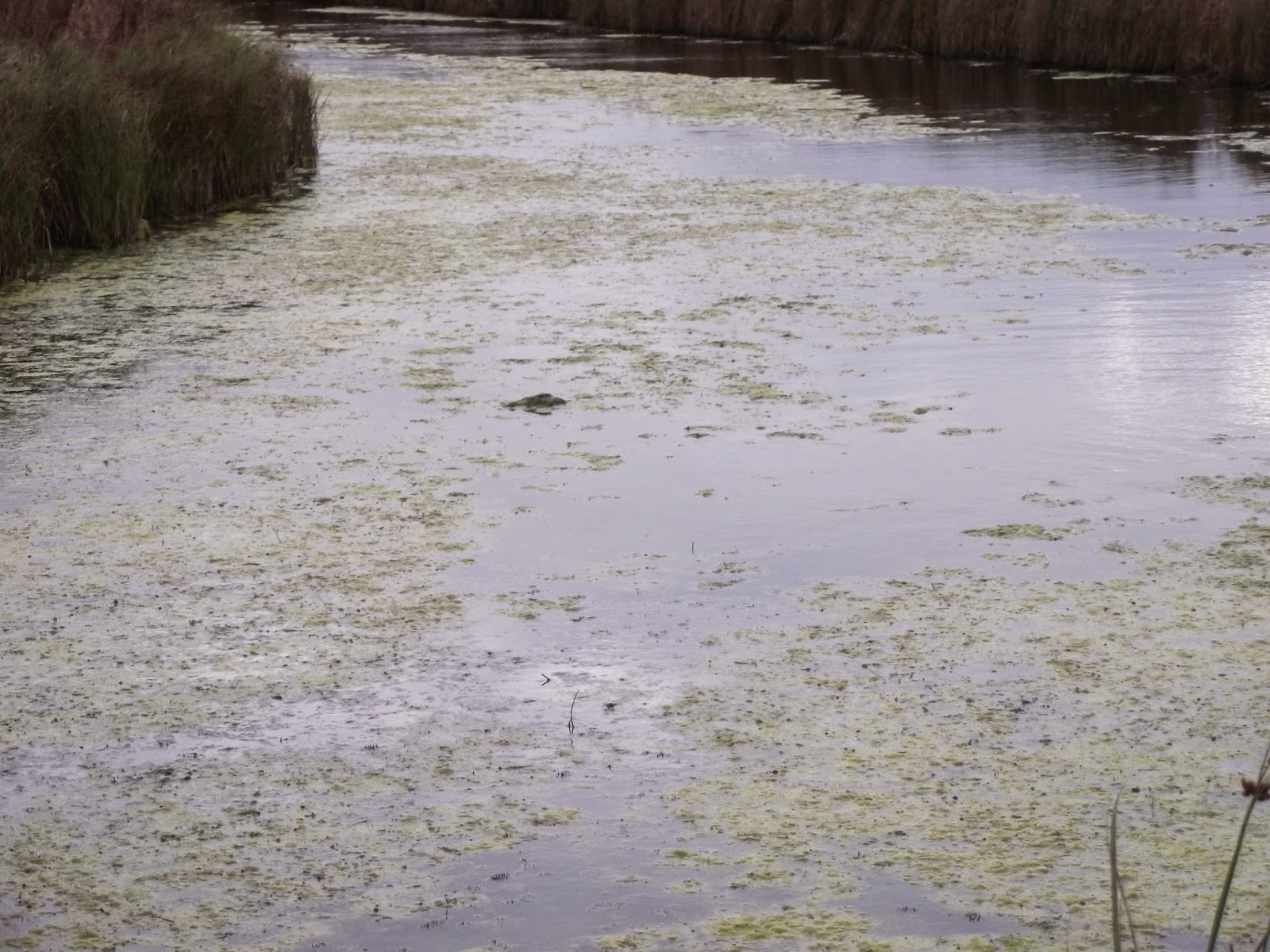
Climbing on top of the sea wall I immediately noticed that the wind was bringing with it the awful stench of the reserve's stagnant ditches and fleets. Virtually no rain for several weeks has seen both the water and oxygen levels in them to drop away quite dramatically and what water that is left in them is either a puce or blue-grey colour. As you can see below, the weed is starting to decompose on the surface and sulphurous bubbles regularly come to the surface.
Whilst I'm always loathe to see the end of guaranteed warm weather, even early mornings this last week or so have been very uncomfortable in very humid and murky conditions and being accompanied by a continuous cloud of hungry mosquitoes all the way round has been intolerable, there was none of that this morning.
Climbing on top of the sea wall I immediately noticed that the wind was bringing with it the awful stench of the reserve's stagnant ditches and fleets. Virtually no rain for several weeks has seen both the water and oxygen levels in them to drop away quite dramatically and what water that is left in them is either a puce or blue-grey colour. As you can see below, the weed is starting to decompose on the surface and sulphurous bubbles regularly come to the surface.
It typifies how the reserve is at the moment, it's very dry and pretty much devoid of bird life, one reason I imagine, that even the wildfowlers have been absent this last week, the Greylags have moved somewhere else and ducks are counted in ones or twos. So many autumns have been like this on the reserve in recent years that it's pretty much become the norm but it makes for some pretty uninspiring walks round, feeling great if you total more than ten of any particular species. Mind you I recall asking for lots of rain this time last year and it really came back to bite me as we had the wettest winter for a hundred years, it's always the same in North Kent, either too dry or too wet.
Early morning on Wednesday saw the first visit this autumn by one of the local hunts and they spent most of the morning working their way round the farmland of Harty looking for foxes. I believe at this time of the year it's called "cubbing", where the young hounds learn from the older ones how to go about fox hunting. Yes, I know that hunting with dogs is banned but that has never bothered the hunts that visit Harty a few times each year and you can hear them actively encouraging the hounds to work through the thickets and reed beds. They are also accompanied by a terrier man on a quad bike, who presumably has the terriers available should any foxes go to ground and need digging out.
Now I'm not going to turn hypocritical and say that I don't agree with killing foxes, because both the NNR's on Sheppey, control foxes throughout the year and I accept that it is a necessary fact of successful reserve management. My only real problem with the hunts is their attitude towards land that they don't have permission to be on, they quite often charge across that without a thought and even get stroppy when challenged. They also, as they did on Wednesday, regularly work the hounds through the whole length of the Capel Fleet reed beds, which have SSSI, SPA and Ramsar status and protection, in order to flush out any foxes, disturbing everything else in the process.
On a far happier note, the Kent Field Club have just published Vol.18 of their regular booklets about various aspects of Kentish flora and Fauna and it is entitled "The Natural History of the Isle of Sheppey". For anybody interested in Sheppey's geology, animals, birds, moths, butterflies, insects, flowers, ditch systems, etc. etc, it is a 270 page booklet packed with colour photographs, maps and numerous chapters written by very knowledgeable people.
It can be bought for £12 + £2 pp by sending a cheque made out to Kent Field Club to Ms. K. Friend, 2, West End Cottages, The Street, Doddington, Kent. ME9 0BZ
Early morning on Wednesday saw the first visit this autumn by one of the local hunts and they spent most of the morning working their way round the farmland of Harty looking for foxes. I believe at this time of the year it's called "cubbing", where the young hounds learn from the older ones how to go about fox hunting. Yes, I know that hunting with dogs is banned but that has never bothered the hunts that visit Harty a few times each year and you can hear them actively encouraging the hounds to work through the thickets and reed beds. They are also accompanied by a terrier man on a quad bike, who presumably has the terriers available should any foxes go to ground and need digging out.
Now I'm not going to turn hypocritical and say that I don't agree with killing foxes, because both the NNR's on Sheppey, control foxes throughout the year and I accept that it is a necessary fact of successful reserve management. My only real problem with the hunts is their attitude towards land that they don't have permission to be on, they quite often charge across that without a thought and even get stroppy when challenged. They also, as they did on Wednesday, regularly work the hounds through the whole length of the Capel Fleet reed beds, which have SSSI, SPA and Ramsar status and protection, in order to flush out any foxes, disturbing everything else in the process.
On a far happier note, the Kent Field Club have just published Vol.18 of their regular booklets about various aspects of Kentish flora and Fauna and it is entitled "The Natural History of the Isle of Sheppey". For anybody interested in Sheppey's geology, animals, birds, moths, butterflies, insects, flowers, ditch systems, etc. etc, it is a 270 page booklet packed with colour photographs, maps and numerous chapters written by very knowledgeable people.
It can be bought for £12 + £2 pp by sending a cheque made out to Kent Field Club to Ms. K. Friend, 2, West End Cottages, The Street, Doddington, Kent. ME9 0BZ
Friday, 12 September 2014
Grass Pollen?
Further to my posting a few weeks ago where I posted a photo of one of my shoes mildly covered in orange dust from the grass on the reserve, well this morning it had increased considerably, as the photos below illustrate. It had even spread onto my trousers.
If indeed it is grass pollen, then it's no wonder that people get hay fever and a probable reason why even my eyes have been sore this year. Can anybody confirm that it is indeed pollen and not simply some kind of dust. Incidentally, my two white terriers, who are at boot height in the grass, always return home as white as they left, why are they not being stained by the dust?
N.B. I have now found out that it is a rust disease of grassland caused by poor growing conditions and the onset of cooler nights.
As for the reserve in general, well it's pretty dire bird wise at the moment as we endure our usual bone dry September conditions and lovely wet Oare is the centre of attention for local bird life. The only real activity on the Swale NNR at the moment is between the wildfowlers and the Greylag geese and Shellness Point, where a few winter birds such as Wigeon and Brent Geese are straggling in.
Monday, 1 September 2014
A New Shooting Season Begins
As is my custom every year, I was on the reserve at 5.15, just as dawn was starting to brighten the eastern sky, to see in the start of the wildfowl shooting season and make my self known and have a chat with, the wildfowlers on the first morning out there.
And what a dawn it was, the sky was split in two, with brightness just showing in the east and stars still out to the west. Gradually however the sky turned to full and blue brightness until, with some speed, a beautiful orange sun rose alongside Shellness and briefly turned the sky a blend of pinks and oranges. It was a perfect September morning.
As I made my way across the marsh towards the sea wall in the half light, shots were already beginning to echo round the farmland with increased regularity, as the dawn light prompted the wildfowl into taking their regular flight lines between roosts and feeding areas. Unless the farmland duck shoots have released Mallard for shooting purposes, ducks are normally at a premium at this time of the year, the main shooting interest is the ever increasing number of Greylag Geese on Harty, especially while they're attracted to the corn stubbles, as below. These photos were taken yesterday on the farmland alongside the reserve and this morning two "duck shooters" were hidden up ready to ambush the geese as they dropped in as normal. Unfortunately for them somebody must of tipped off the geese because not one showed any interest in that particular field today, despite the shooters regularly using their goose call thingy which is supposed to sound like a Greylag Goose but in this case sounded like somebody standing on a cat's tail.
However, despite these two guy's bad luck, that was obviously not the case further out behind them on the marsh. The corn fed ditches and Capel Fleet below Muswell Manor were being heavily shot, something that carried on for an hour or so and at one stage some geese began to circle round and move further inland. Three however, broke away from the flock and as I climbed up on to the sea wall they headed out across the saltings to the tide where the wildfowlers, who had had no shots at all till then, bagged them.
That does tend to be the big difference between the true coastal wildfowlers and the inland "duck shooters", the wildfowlers, as you can see below, tend to prefer a solitary existence out on the saltings, often standing in deep tidal mud and getting the odd shot at what few wildfowl fly out that way.
Not for them the comfort and limited challenge of sitting round corn fed duck ponds and fleets inland, shooting large and unnecessary bags of wildfowl every visit.
When the wildfowlers eventually finished and came back to the sea wall we sat in the warm sunshine of a beautiful morning, listening to curlews and other waders out in the estuary and swapped chat about shooting, conservation and the countryside in general, it was great.
And what a dawn it was, the sky was split in two, with brightness just showing in the east and stars still out to the west. Gradually however the sky turned to full and blue brightness until, with some speed, a beautiful orange sun rose alongside Shellness and briefly turned the sky a blend of pinks and oranges. It was a perfect September morning.
As I made my way across the marsh towards the sea wall in the half light, shots were already beginning to echo round the farmland with increased regularity, as the dawn light prompted the wildfowl into taking their regular flight lines between roosts and feeding areas. Unless the farmland duck shoots have released Mallard for shooting purposes, ducks are normally at a premium at this time of the year, the main shooting interest is the ever increasing number of Greylag Geese on Harty, especially while they're attracted to the corn stubbles, as below. These photos were taken yesterday on the farmland alongside the reserve and this morning two "duck shooters" were hidden up ready to ambush the geese as they dropped in as normal. Unfortunately for them somebody must of tipped off the geese because not one showed any interest in that particular field today, despite the shooters regularly using their goose call thingy which is supposed to sound like a Greylag Goose but in this case sounded like somebody standing on a cat's tail.
However, despite these two guy's bad luck, that was obviously not the case further out behind them on the marsh. The corn fed ditches and Capel Fleet below Muswell Manor were being heavily shot, something that carried on for an hour or so and at one stage some geese began to circle round and move further inland. Three however, broke away from the flock and as I climbed up on to the sea wall they headed out across the saltings to the tide where the wildfowlers, who had had no shots at all till then, bagged them.
That does tend to be the big difference between the true coastal wildfowlers and the inland "duck shooters", the wildfowlers, as you can see below, tend to prefer a solitary existence out on the saltings, often standing in deep tidal mud and getting the odd shot at what few wildfowl fly out that way.
Not for them the comfort and limited challenge of sitting round corn fed duck ponds and fleets inland, shooting large and unnecessary bags of wildfowl every visit.
When the wildfowlers eventually finished and came back to the sea wall we sat in the warm sunshine of a beautiful morning, listening to curlews and other waders out in the estuary and swapped chat about shooting, conservation and the countryside in general, it was great.
Subscribe to:
Posts (Atom)