Thursday, 27 December 2012

RSPB HARTY


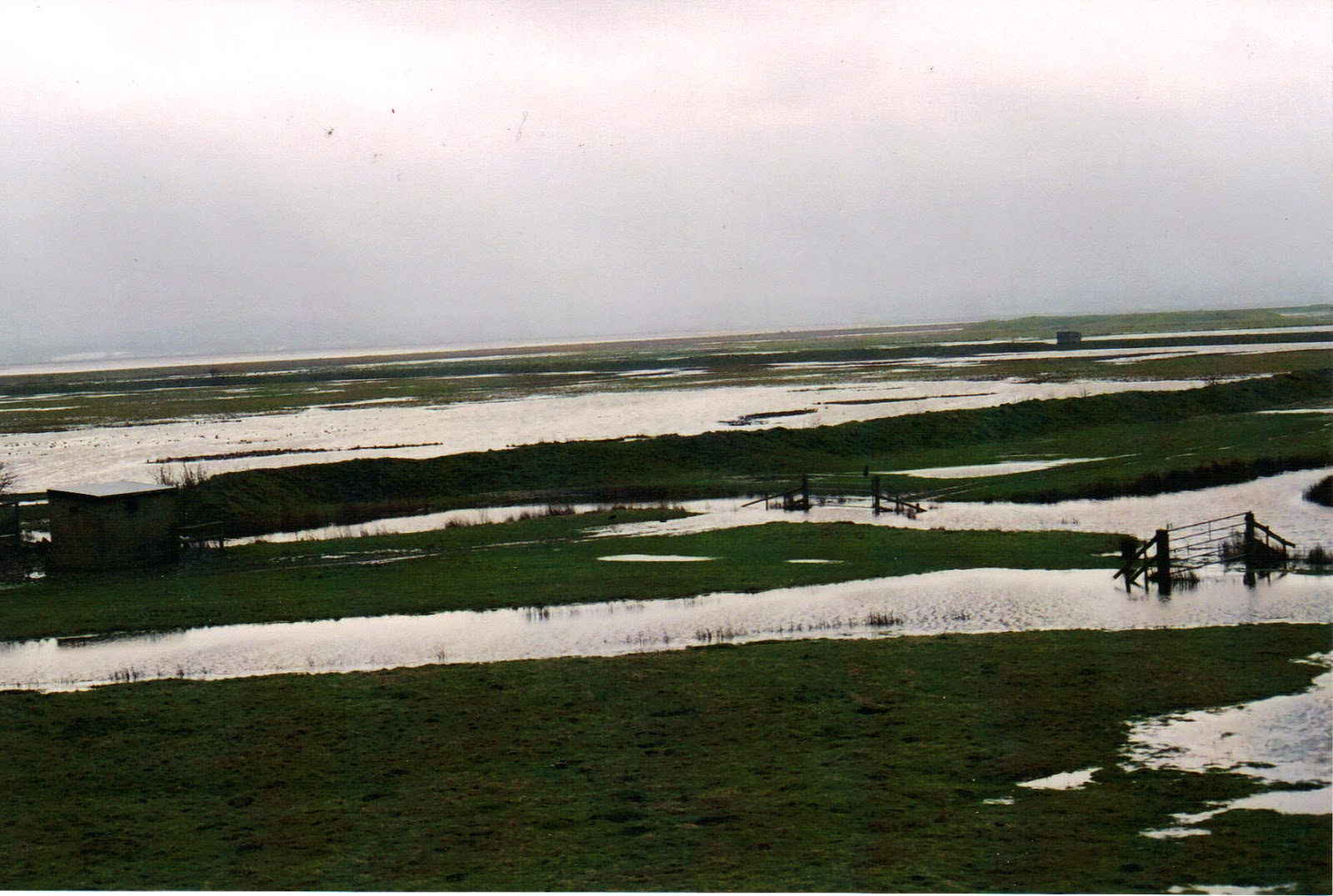
Continuing my theme of recent posts regarding the flooding at Harty, Sheppey, some of you will recall visiting the two RSPB fields below Muswell Manor, Leysdown last winter in order to spot the Lapland Bunting flock that had built up there. The buntings were feeding on the weed seed in both of the fields and the flock built up to around 60 odd birds.
The two fields are seperated by a raised bund and I took these photos this morning at sunrise, standing on the bund looking towards Shellness Hamlet. All four photos are of the left-hand field, which as you can see, indicates the extent of flooding both on those two fields and on The Swale NNR alongside. Hard to believe buntings were feeding in this field last winter. (Sorry about the darkness of the photos but sunrise was being threatened by approaching dark rain clouds at the time)


Wednesday, 26 December 2012

Boxing Day Blue Skies


Getting up this morning at 5.30 as usual, the first thing I spotted out of the window was a full moon setting in the western sky, and a clear sky full of stars at that - actually no rain for once! That definitely meant an early visit to the reserve to take full advantage of a potential sunny and dry morning - such a rare occurrence just lately.
With the area around the reserve barn somewhat flooded and mucky I parked the car at Elliotts Farm on the bend of the Harty Road and spent 10 mins. walking down to the reserve. As you can see from the photo above, it was still fairly dark as I did so and only towards the east was there any lightness in the sky, but it was really great and both myself and the dogs were overjoyed to be out again after spending all day yesterday indoors.


Arriving at, and leaving the reserve barn behind, the next daunting task was to attempt the somewhat hazardous trek across the marsh to the sea wall. Above you can see the gate upright in the flood which indicates where the track is, once through that you turn right and wade through huge areas of flooding and soft mud to get to the sea wall in the distance, not made easy by the limited light.


Halfway across, I stopped to take yet another photo of the flooded grazing marsh. Some of you may recall my posting with the purple toadstool a few months ago, this is where it was taken, hardly condusive to fungi growing now!
It's hard to convey how hard that journey across the marsh now is, you are either wading through water that threatens to flood your wellies, or forever pulling your feet, step by step, out of deep and clinging mud. But hero that I am, I eventually climbed up onto the lofty heights of the sea wall and took in the beauty that is The Swale with the dawn sky behind it. Being Boxing Day, that traditional day for killing things in the countryside by various groups of people, I had anticipated, indeed trekked through mud and water to confirm it, that there would be numerous wildfowlers on the saltings in front of the reserve. A squint through my binoculars though, through the fast improving light, only found one such hardy soul and clearly with no visible wildfowl about he wasn't having the best of mornings. Not long after, once the sky had brightened to that of daylight and the sun threatened the horizon, he cleared off home, explaining to me how depressing and quiet it all has been. I could see what he meant, a scan around the reserve found excessively flooded fields and ditches that had burst their banks, conditions heaven made for wildfowl and yet there wasn't a duck or goose to be seen at all. A few small flocks of Lapwings and Carrion Crows, the odd Curlew and Mute Swan and that was it, how does a reserve with such perfect conditions become so empty, we had a crap summer, surely the winter  isn't going to be as bad.

I carried on back across the reserve by a different route, it took me and the dogs through the current sheep flock, looking a tad unhappy in such wet conditions, although I know little about what's good or bad for sheep. One was trapped on its side away from the flock, it regularly happens with sheep with thick fleeces, after lying down they sometimes find it difficult to get upright again and if left for a long period of time, they lose the blood supply to one limb and can eventually die. A bootful of water later I got across to the sheep and struggled to get it upright by lifting it up and supporting it against my leg until the blood supply returned to the dead leg. I tried to walk it around until it returned to normal but it was struggling and regularly fell back over again and so I rang the grazier and left it to him to arrive and sort out the problem.

Moving on and smelling like the inside of a sheep pen, something the dogs reminded me of by keeping their distance, I still hadn't seen a decent bird. I passed another two duck shooters, sitting round a farmland duck flight pond the other side of the reserve fence, they too had seen nothing resembling wildfowl and were just packing up. However, eventually bingo happened, I came across three Pied Wagtails and with them was a Water Pipit - my first ever, it all turned out a good day, blue skies, sunshine and a new bird, it was worth coming.

Wednesday, 19 December 2012

A Year of Extremes


The flooding on the reserve continues to increase by the week and with another series of rainy days forecast for the next week, things look like getting worse. We haven't quite reached the levels seen in the photos above, taken around five years ago, but it's a fair bet that early into the New Year we will have done.
Obviously it makes fantastic and attractive habitat for all manner of wildfowl and wading birds and indeed, they become spoilt for choice so to speak, but it makes it bloody difficult, indeed depressing, trying to find a way round the reserve without wearing chest waders. Unless we get a very dry March, which often happens, conditions look set to stay awkward until at least April, which seems an awful long way away!

Looking back through the year, it's certainly been one of extremes as far as conditions have been concerned.   We began 2012 in the middle of a winter drought and despite a few days of snow cover, it remained dry until the end of the winter. Indeed, by the end of March all the ditches, fleets and rills on the reserve were either dry or containing just a few inches of water and it did not bode well for the breeding season that was just beginning. However, as we now know, things changed dramatically during April and we quickly went from one extreme to the other, during April and May it not only stayed cold but it got wetter and wetter. The water courses quickly re-filled to their normal levels but more importantly, as the vegetation began to grow it stayed both wet and cold for long periods of time and with little sun to dry and warm them, the chicks of ground-nesting birds began to succumb to the cold. Birds such as Lapwings, Redshanks and even Skylarks, struggled to keep their chicks not only dry and warm but supplied with the few insects that there were about. Three pairs of Marsh Harriers nesting in rape nearby all saw their chicks succumb as the weight of the wet foliage saw the plants collapse over the nests, making access difficult.
Eventually our counts for The Swale NNR showed just 26 breeding pairs of Lapwings (a 42% drop on 2011) and only c. 4 chicks fledged. Redshanks also fledged very few chicks and even our resident pair of Barn Owls had their chicks die while still in the nest, presumably due to the parents finding it difficult to hunt for food in constantly wet vegetation.

It was quite frankly a disaster of a breeding season all round, borne out as we went into June, by suggestions that it was the wettest summer on record. That for me, was also a bit of an extreme statement, or it was where Sheppey was concerned, because as June progressed into July and August and we did eventually get some warm and dry weather, the reserve began to quickly dry out again. It certainly wasn't the kind of blistering weather that I would of liked but the reserve continued to dry out and lo and behold, by September we were back to near drought conditions - quite incredible, no water, no wildfowl and few waders! The continuing statements in the papers of how it had been the wettest summer on record all seemed a bit daft as we looked at parched rills and low ditch levels again.
And now, just to complete this year's mad merry-go-round of weather extremes, we are approaching flood levels again across the reserve, could we possibly fit in sweltering temperatures in the two weeks that are left - I somehow doubt that.

Monday, 17 December 2012

Harrier Roost Counts


Arriving on the seawall yesterday afternoon at 3.15, ready to carry out this winter's 3rd Harrier Roost Count, this was the scene that greeted me. The saltings were part covered by a high tide of around 6.0 metres in height. The water gradually receded, as did the light, but it had the effect of deterring any Hen Harriers coming into their traditional roost site on the saltings down towards Shellness Hamlet.
I was also surprised to watch a lone wildfowler and his dog make their way along the seawall later than usual and somehow find a way to get out to the seaward edge of the saltings, without disappearing down any of the flooded rills. The tide was ebbing fast as he positioned himself out there and large parties of Wigeon, Mallard, Shelduck and Brent Geese were drifting past on the fast moving tide, fortunately well out of his range, he could only watch them pass by.
It was indeed one of those late winter afternoons when a high tide one side of the seawall and a well flooded reserve the other side, combined to make very attractive conditions for a wide range of birds, in large numbers. Out on The Swale were some largish flocks of the birds mentioned above, all drifting with the tide and they all seemed to be eventually funneling into the bay created by the shell spit of Shellness Point, which itself had a reduced area due to the height of the tide. On the Point itself, the daily high-tide roost of waders displaced by the tide was well packed with large numbers of Oystercatchers, Dunlin, Knot, etc. and at regular intervals these would all rise into the air and swarm around like distant mosquitoes above a pond, well I was a mile away!
The flooded conditions on the reserve were just as productive and there was a mixed flock of c.500 Brent Geese and 40 Greylag Geese, there were Redshanks, Curlews, Herring and Black-headed Gulls, Mallard, Teal, a couple of Water Rails squealing in the Delph reed beds, Skylarks, Mipits, Reed Buntings, a Sparrowhawk and finally, two Bearded Tits on the reed tops. It was a noisy and scenic winter's dusk and by 4.00, as the light faded fast, the first of three single ring-tail Hen Harriers made it's way along the saltings towards Shellness where it dropped into a raised section of vegetation. It was soon followed by the other two harriers but just as they were about to drop down the wildfowler discharged three rapid shots at what seemed to be an empty sky. He repeated that shortly after and I can only assume that he was trying to scare up the wildfowl that were passing by on the tide with the hope some would pass over him. Unfortunately all it did was to twice startle and scare up the harriers and as I left for home they were still slowly circling round.
All that was left then was the trudge back across the reserve through much surface flood water and areas of clinging mud churned up by the feet of the cows and sheep. It's tiresome hard work in the daylight but in near darkness, trying to avoid the deepest of these areas is quite daunting and I eventually arrived back at the car both wet and wanged out, with two Jack Russells looking very similar - the joys of volunteering for surveys!

So, in the end my count for the evening was just the three Hen Harriers, but along one section of Capel Fleet on Harty 32 Marsh Harriers went into to roost in reed beds, with only one being a male bird. Elsewhere, at a Kemsley reed bed, yet another 32 Marsh Harriers roosted and there 5 were males among those. More counts have yet to be declared but I would expect another 40-50 Marsh Harriers from another Harty site so it all looks good, for Marsh Harriers at least.

Wednesday, 12 December 2012

Scarecrows and Frost


Four weeks ago the field above was green and lush with 3in high winter corn. Two weeks ago a flock of 600-800 Brent Geese found it and spent every day then after, eating the green leaves and gradually mowing their way across it from one end to the other. They have left the corn no higher than the soil it is growing from and although with mild weather it will almost certainly recover, it will be some weeks behind where it should be. Somewhat "after the horse has bolted", the farmer has now put a couple of scarecrows and a gas gun into the field and since then the Brents have not returned, but I think that's more a case of nothing left to eat than being scared off.
The extent of lost corn foliage is quite great and its easy to see why farmers eventually lose their patience with the geese and apply for licenses to begin shooting them, although the license issue is greatly flawed.

After a night of severe frost and freezing fog here on Sheppey, this morning after the fog cleared, turned out to be quite scenic with blue skies and sunshine lighting up the hoar frost covering every bush and tree. Here below you can see the frosted hedgerow along the Harty Road, which incidentally, was packed with Fieldfares and Redwings as I drove past.


The concrete track running down to the reserve from Elliotts Farm looked equally as impressive.


On the reserve itself this morning, I never saw that much because shortly after I got there the mist rolled in really thickly again and stayed like that for an hour, before disappearing just as quickly. At first it was quite weird because I had sunshine in front of me and closing in fast behind was a thick wall of mist. It was a bit like a film I saw one time with Jamie Lee Curtis in it, called "The Fog".

Any way, as I say, the mist cleared, the sun re-appeared and I couldn't resist this second photo of another one of the neighbouring scarecrows, this one looking quite ghostly as it stood there.


Friday, 30 November 2012

Sunny and Serene


After a week of rain, cold winds and cloudy conditions, what a joy it was to be on the reserve this morning. The ground white with frost, clear blue skies and the sun hitting me in the face as I drove down to the barn, it was fantastic.


 Even the flooded areas looked better with a blue sky reflected in them, they weren't any less hard to negotiate but they looked better. The Delph Fleet alongside the seawall (below) had barely a ripple on it and Bearded Tits "pinged" as they made their way along the reed tops.


The whole area had a real feel of warming sun and serenity about it and even the cows seemed to be grazing quieter - mmm, think I'm getting silly now.


One thing was for sure, with the ground made firmer by the frost for a while, I was able to forsake the 'orrible wellies and wear my walking boots for a change, so much more comfortable for the old arthritic feet. So by picking a route that avoided the worst of the deep water, deep mud and fresh cow shit, I had a really enjoyable walk round. (Reading one local blog this week where the guy's patch is mostly woodland and hedgerows, I was amused to see him saying how depressing it was because the ground had puddles and it was squelchy. (Try a day on the North Kent marshes at the moment you poor darling and you'll find out what proper squelchy is!)

Anyway it all began really well because the first birds that I clapped eyes on were six Brent Geese feeding in winter corn alongside the reserve and one of them was my first ever Black Brant, which considering I saw my first ever Pale-breasted Brant yesterday, quite made the week. (I came over all Twitchery then but hopefully it'll soon pass).
The next thing that quickly became apparent was that at long last birds are beginning to move in and utilize what we've painstakingly spread out before them - lots of water, lots of boggy ground, even some fly-covered cow pats, nothing like it for wildfowl and waders! They were all mostly in and alongside the "S Bend Ditch", where a grazing field was part flooded, but with the sun behind them I was mostly looking at several hundred dark shapes. But my cunning plan of simply walking the long way round behind them worked, well cunning except for the fact that I stood in a cow hoof print full of water and had liquid mud squelch all the way up a trouser leg to my crutch.

But anyway, apart from being wet I was now able to identify all the birds in that one field and flooded Ditch. It amounted to c.500 Lapwing, 200 Brent Geese, 120 Teal, 70 Mallard, 8 Snipe, 12 Mute Swan. Best of all though was the fact that what at first I assumed to be simply c.20 Greylag Geese grazing, turned out to be 12 Greylags and my first 10 White-fronted Geese of the winter, which promptly took flight. Once again I had to rub the old hanky across the brow as those feelings of being Twitchy rose to the surface again.
That was pretty much all the excitement for the day, the rest of the walk round was spent enjoying the increasing warmth of the sun, mulling over the poetic things I was gonna write on my blog when I got home, and looking at the current Wood Pigeon spectacle. The farm fields between the reserve and Shellness Hamlet, a huge acreage, still retain most of the maize crop that was sown earlier this year. A brief attempt to harvest the crop a couple of weeks ago but it quickly became evident that the ground was too wet to take the weight of the combine harvester and so the crop has been pretty much abandoned. This has seen many thousands of the maize cobs dropping their corn onto the ground below, with the result that we seem to have every Wood Pigeon in Kent out there feeding in the fields. The flock has gradually built up as pigeon-post gets around and it currently stands at around 3,000 birds, a spectacular sight every time they take flight as something disturbs them.
Yesterday that disturbance came in the form of the weekly farmland game shoot, which decided that the first drive should be through the maize fields at the rather opportune and easy targets of several thousand massed pigeons. For a brief spell the shooters did spectacularly well as the birds kept getting up in front of them and I imagine much pigeon pie will be eaten this weekend.

So with a bit of luck, we'll get a nice hard frost again tonight and I'll get out at first light tomorrow morning and get some nice views of a big, orange sun, climbing up above Seasalter as dawn breaks.

Wednesday, 28 November 2012

Water, Water, Everywhere and yellow fungi.


Well, as is to be expected after the rain of the last week, the reserve is now starting to flood up quite well now, although we still have some way to go before we reach the levels, or should I say depths, of the 2008/9 winter. The view above greeted me today as I pulled up to park at the reserve barn, entry on to the grazing marsh now requires the wearing of wellie boots. The ditch either side of the gate is fed by all the water draining off the farmland alongside and has now flooded across the gateway. It's bad enough having to wear wellies but when you only have short legs like the dogs its all a bit much and although Midge was having second thoughts, Ellie showed us how to do it.


However we all got through OK and the view below shows that the water is now creeping back up the track to the front of the barn. Although the water near to the barn is only a few inches deep at the moment I was amazed as I approached it, to see minnows zipping about in it, that far away from the ditch proper.


Turning 180 degrees to begin walking round the reserve, the photo below shows what faced us (the straight lines in the middle are the track). You can just make out the white shapes of the sheep in the distance on ground that is only slightly higher and in the 2008/9 winter even that was all under water, but we're getting there.


This ditch is just behind the sheep above and runs across to the sea wall. As you can see it has now begun to flood out onto the grazing marsh. Incidentally, the bund to the left-hand side of it is where the Desert Wheatear was seen a couple of weeks ago, its obvious why it never hung around!


Getting across that ditch entailed going through this raised but still flooded gateway, which my wellies only just cleared in the middle. Midge seems to be having second thoughts, the way back looks far more appealing!


Below is the start of the "S Bend Ditch", which you can see has flooded outwards in all directions. This time last year, right through until this April, that ditch, or Stone Fleet to give its proper name, was bone dry. If previous years are anything to go by, that gateway and track will now be inaccessible until at least May next year. Oddly enough though, and despite a lengthy walk round, expectations of seeing large numbers of Lapwings and Golden Plovers on the waterlogged grazing fields, came to nothing. Clearly with the whole of Harty equally waterlogged the birds are spoilt for choice but one would of expected far larger numbers than the few dozens that we are currently experiencing. A few curlews fed in the grass while the tide was high and around 200 Brent Geese grazed alongside some Mute Swans in a flooded section but really, a dozen newly arrived Gadwall were the best thing on offer apart from Hen and Marsh Harriers.

Lastly, you might recall my photo of a bright purple fungus a few weeks ago, well today on the sea wall I found this bright orangey-yellow one, which remains unidentified as yet.