Friday, 26 December 2014

A Marshman's life

Yesterday morning, Christmas morning and with the weather being quite exceptional under clear blue skies and sunshine, I had a walk along the track between Elliotts farm and Muswell Manor on Harty. Some of us know it as the "concrete road" and it was a nice change to walk on firm ,dry ground rather than the flooded conditions of the reserve.
The unique feature of this track is that for part of it's length it runs along a ridge of high ground with views across the Swale NNR one side and the rest of Harty marshes the other and yesterday those green pastures could not of looked much better. No one about, total quietness, just the two dogs and me and for a while it was as though I owned a part of heaven.


 This morning was different all together, an overnight frost had begun to lift as high, grey cloud drifted in at dawn and it soon became a very cold but gloomy morning as the marsh was lit by the increasing light. Driving along the Harty Road I stopped at Capel Corner and checked out the various wildfowl sheltering along Capel Fleet, it pretty much amounted to just Mallard, Teal and Coot.

 
Mind you, the farmland either side of the Fleet is always worthy of a check, this week there have been reports of two flocks of geese along there. Around 80+ White-fronted Geese have been seen on the farmland to the left of the Fleet and a mixed flock of c. 50 Pink-footed and Bean Geese on the left. Short-eared Owls, Marsh and Hen Harriers, Peregrines and winter thrushes are also becoming more regular along the Harty Road it'self, so it's all looking pretty good at the moment.

Leaving Capel Corner behind, it was on to the reserve at first light, on with the wellies and another trek across the mud and water to the sea wall but at least the cattle have now been taken off till the Spring. It won't make the horrendous muddy areas any better but at least they won't increase now, it's a shame that the cattle are allowed to create so much damage to long into the winter. The cattle will now be in their Eastchurch stock pens, ready to calve over the next few months and not due back until the warmth and dryness of April. Given that it was Boxing Day and a traditional hunting/shooting day on the calendar, I made my way across to the sea wall expecting to see several wildfowlers out on the saltings but no, there was just the one, the same guy mentioned in my last post and still as bored at little shooting opportunity. He lives on Sheppey and we had a pleasant chat once he'd made his way back along the sea wall with his dogs, to where I was with mine. Apparently he's 60 tomorrow and was beginning to feel that perhaps sitting out in the mud, the frost, the cold and generally crap weather, was just beginning to lose it's appeal for him and at 67 I know just how he feels. In your 60's and soon, 70's, it takes a lot of determination with arthritic bones, to suffer the slog of so much water, mud and intense cold at dawn each winter - sometimes a later start in sheltered woodland places does seem an attractive proposition - but no, I'm a marshman through and through, it, like the aches, pains, mists, cold and damp, are in my blood, it's all I know. 

Sunday, 21 December 2014

December Dawn

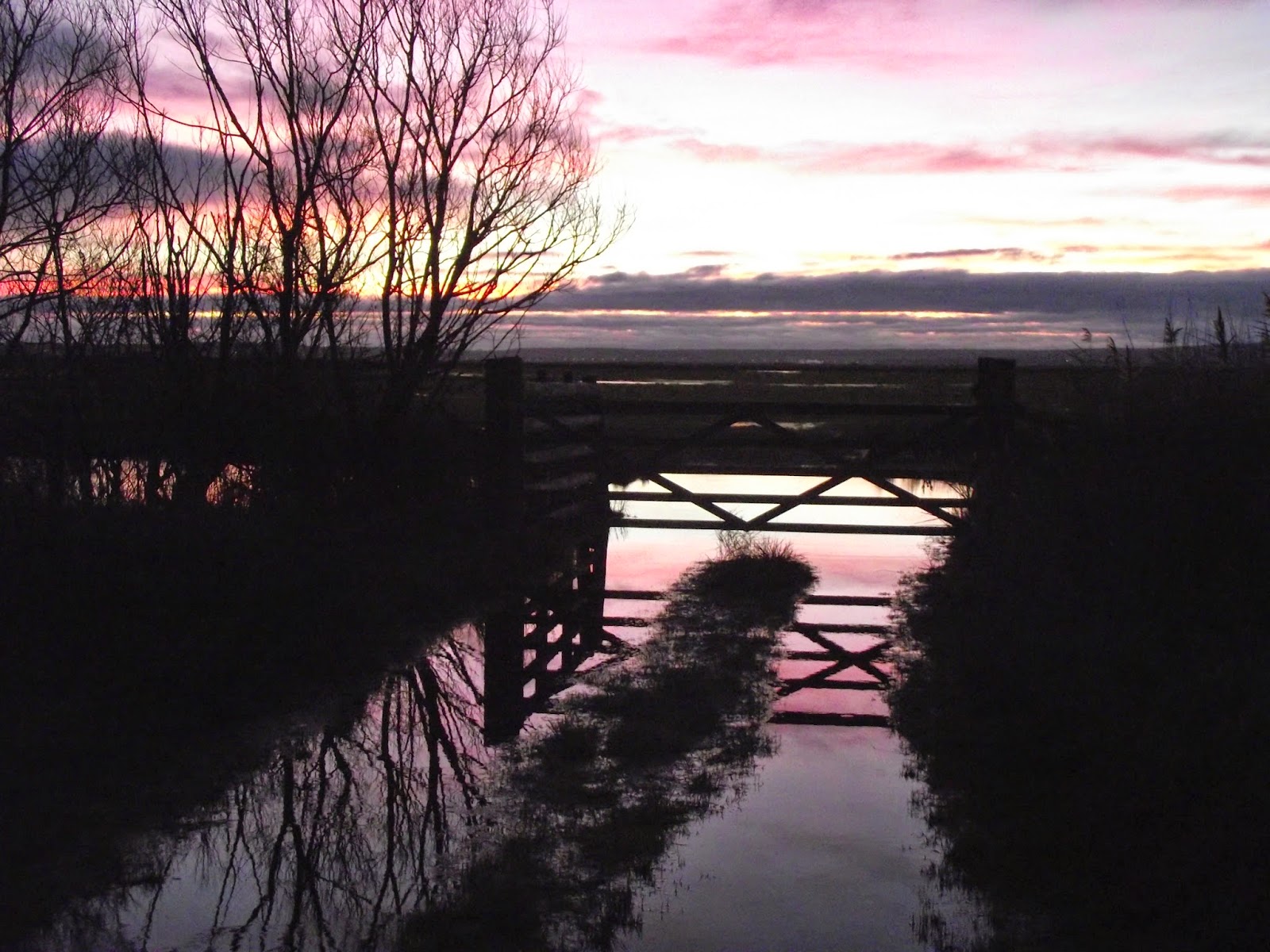
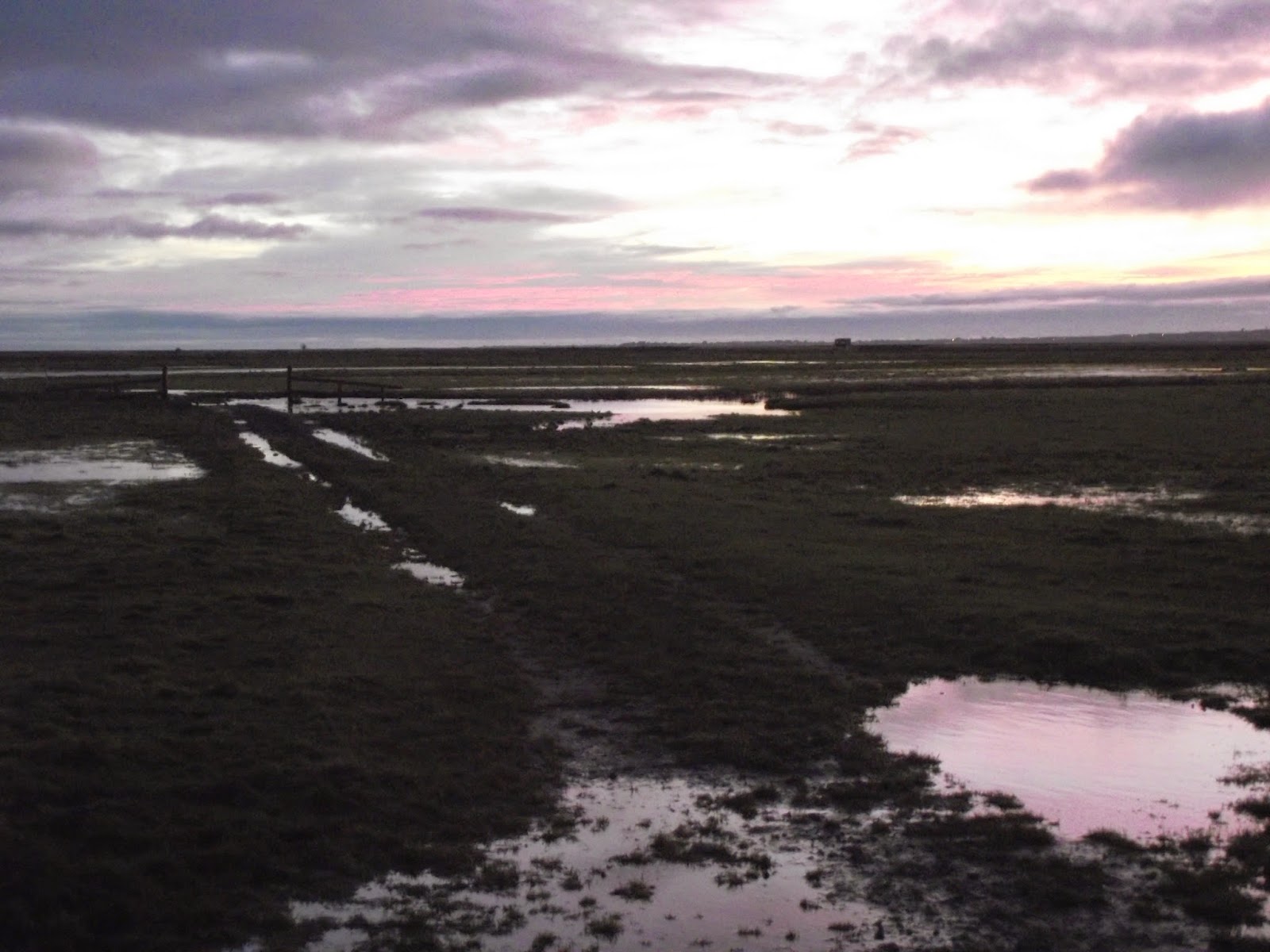
I arrived at the reserve barn just as it was getting light this morning, as you can see below.


The first obstacle is the barn gate onto the marsh, where the ditch either side has joined up across the track to create foot deep water.


Turning left onto the track I began the daily daunting task of wading my way through much mud and water to get to the sea wall hide, visible below as a tiny square on the horizon in the centre of the photo.


This is the gate-way, 50 yards past the photo above, and turning right, into the water.....


 I carried on through the cattle, (responsible for a lot of the mud), as the light gradually improved.......


and through even more water to eventually climb up onto the seawall and visit the hide.


For any birdwatcher viewing the reserve from the comfort of the sea wall, the reserve, with it's large areas of flooded grazing marsh, must look pretty much perfect for attracting birds at this time of year, which of course it is. For me, getting old and arthritic and entering via the management entrance to the rear of the reserve, the challenge of walking round in deep, clinging mud and water each day leaves me feeling like I've done a mini assault course each time.
And was it all worth it this morning, well no in all honesty. My early start was to hopefully have a chat with any wildfowlers that might be there but there was only the one and he packed up early through boredom and the failure to fire a shot. For whatever reason, the wildfowl numbers that have been steadily building over the last 3-4 weeks have dropped off this weekend to leave 1-200 Mallard, 20-30 Gadwall and the usual 100+ Greylag Geese. The White-fronted Goose flock was totalling 84 birds in mid-week but they have been absent for a couple of days and Wigeon, well, unless we get a severe cold spell, the days of counting them on the reserve by the thousands, have been consigned to history now. Sure there were birds about but not in the numbers that the conditions should be attracting, I could probably make out a list that was fairly long, but most of the birds featured would only be counted in totals of less than ten or twenty.
The biggest count of the morning was a herd of 117 Mute Swans, feeding pretty much undisturbed in a field of rape alongside the reserve. This same field had been ravaged for the last month by a large flock of Brent Geese but numerous gas gun bird scarers had finally scared them away and the gas guns had fallen silent, until that is, the swans had moved in, Now the swans are happily chomping their way through what I presume is an appetising and free green meal, the gas guns will soon be back!

In summary, if we get a nice clear and sunny, frosty day then the mood to enjoy the conditions will be enhanced considerably but at the moment, struggling through all that mud and water is not fun, it's just a necessary evil - today was the Shortest Day, roll on the Spring.

Saturday, 20 December 2014

In Memorium

Yesterday at Harty Church, the funeral took place of one life's really nice guys - Steve Gordon from Elmley. Steve had been at Elmley for around 30 years, for many of them working for Kent Wool Growers and just helping out on the reserve but in recent years as the Elmley National Nature Reserve's farm manager, living in the bungalow to the right of the car park.
I first met Steve in 1984 when he joined the same badminton club as myself in Sheerness and together one weekend we won the Men's Doubles Plate in an all day badminton tournament that year. For many years after that we only bumped into each other occasionally when our paths between Elmley and The Swale NNR crossed. But for the last 10 years or so, once he had taken on the mantle of reserve manager at Elmley, and the Elmley Conservation Trust had also taken on responsibility for managing The Swale NNR, we got to see each other quite a bit again and worked together in the best interests of The Swale NNR.
Steve was a very fit guy who loved being fit and playing tennis, cycling and ski-ing and who had a wide circle of friends around Europe and it was a great tragedy last year when out of the blue, he was diagnosed with a tumour on the brain. Over the last year and a bit, despite an operation and intensive and sickening treatment Steve never gave in to the illness and pain and was out most days on the quad bike with Max his dog, until the last few months. His combined knowledge of reserve management, animal husbandry and wildlife, will be greatly missed at Elmley and hard to replace, and presumably, with his passing the reserve will now move on into a new era.

"he walked abroad in a shower of all his days" ..........dylan thomas

Wednesday, 26 November 2014

Not Quite So Glorious Mud

After even more heavy rain during the night and with it being an awful, misty, murky day with poor visibility, it's hard to believe that the great outdoors can get any damper. Water runs off or out of every field and along every road, and every tree, bush or patch of vegetation seems to be dripping like a permanently running shower. As someone who is very much a warm and sunny weather person, it's my personal nightmare, especially now that the reserve has already attained water levels not reached until January last winter. The cattle are not helping things on the reserve either, when not wading through large lakes of standing water, I'm having to negotiate gateways that they have reduced to large areas of foot deep, muddy bogs. I've also lost count of the times that I've stood in a flooded cow's hoof print and had muddy water squelch up the front of my trousers and coat. Two hours walking round there at the moment leaves me with all the aches and pains of not only doing an assault course but looking as if I also rolled in it - but if nothing else, the birds love it and are starting to turn up in better numbers.
Water, water, everywhere is also starting to mean birds everywhere as well. Yesterday there were 30 White-fronted Geese on the reserve, plus 180 Mallard, 38 Gadwall and small numbers of Teal. At high tide, waders have re-established their high tide roosts on the reserve as well, especially in the Flood Field in front of the Sea Wall Hide, Bearded Tits and Water Rails are in the reed beds alongside the hide and Marsh Harriers, a ring-tail Hen Harrier and occasional Short-eared Owls are seen most days hunting throughout the marsh. The only thing I would say, is that unless you are wearing wellies and have strong legs, don't bother trying to go round to the Tower Hide, the gateways are awful.

Now, regular readers of my blog will be familiar with my occasional rants about the visits by one of the local Fox Hunts to the Harty farmland and how they still hunt in the normal, pre Hunting Ban way, causing all manner of disturbance. I've always thought that it was something that only happened, tucked out of too many people's view, on Sheppey but it appears not. Reading another excellent blog from Kent yesterday, see www.ploversblog.blogspot.co.uk - you will see that he witnessed just the same thing happening on the Walland Marsh, where once again it was proper hunting, not scent trailing that was taking place.
In all probability fox hunting in the traditional way still continues throughout England on a regular basis and the Hunting Ban only really exists on paper and in the minds of those silly enough to believe that it was ever a victory for the anti-cruelty campaign. It was a win-win situation really, the Hunts still carry on hunting and the antis are happy to believe that they got it stopped - sorted!

Lastly, while I'm having a moan, at one end of the reserve sea wall this morning, I could see three birdwatchers watching the geese on the marsh, so I spent half an hour walking towards them thinking that I could share a bit of reserve bird knowledge with them. Imagine my surprise, or should I say disgust, that when only about 100yds from them, they picked up their scopes and sped off away from me - miserable, unsociable gits!

Thursday, 20 November 2014

Pebbles from my Childhood

Throughout my childhood in Sheerness in the 1950's the one place that was always constant was the nearby beach. Through the long, hot sunny days of summer or the wild, stormy days of winter, it was a regular playground, a place where to us children you seemed to stand on the very edge of a big, wide world that stretched to eternity.
We lived four, small, terraced streets back from it but could stand at the end of our alley, look along Richmond Street, that linked our side streets and roads and there, 3-4 hundred yards away was the sea wall and beyond it the wide and pebbly beach. On those hot summer weekends when package holidays were still being invented, it overflowed with people of all ages, swimming, picnicking, walking in their Sunday bests, and escaping from the hot and dusty streets and dog-shit alleys behind. On the promenade there were three, tile-roofed and open-sided shelters where people could sit out of the hot sun or cool wind and watch people watching them. At those shelters as we grew older we met and courted our girlfriends, or on rainy summer days, left our clothes, while we swam because we had this notion that the water was always warmer when it was raining.
The stretch at the end of Richmond Street, our stretch, was about a quarter of a mile long, it's eastern end featured the old Cheyne Rock Coal Pier, leading to the beaches and green countryside of Minster. It's western end had a short row of beach-side houses known aptly as Neptune Terrace, a couple of arcades and a short jetty where we sometimes fished with our hand lines and caught crabs and "boot-lace" eels. Beyond there was the further beach that led past the large Catholic Church, fairground and onto Garrison Point and the naval dockyard.  As we grew older and more confident in our childhood we occasionally made excursions to the east and west, particularly the fairground, but at first we stuck to our beach and the arcades.
There, on calm and early winter's evenings, well before my teenage years, I would stand on the promenade in the dark and look across the wide and sloping beach, lit dimly by the street lights behind me. I would stare out at at the inky blackness of the sea beyond and dream about where it's seagull, porpoised and fish-filled expanse went, well beyond the winking lights of the distant ships at anchor. I would listen to the tiny, silvery wavelets lapping on the shoreline, leaving just a whisper of sound before the sea reclaimed them back again.

Marine Town, as that part of Sheerness was grandly known then, had two sides. Neither was really the back or the front, it was just the beach one way or the Canal and the fields and marshes the other, with our dingy streets stuck in between. But for the first twelve years of my life it was all I knew and we made our fun and adventures from what there was and the beach was one of those places. When I wasn't standing in the dark dreaming about far off places, there was the day time. Always there were naval warships and sometimes submarines passing by out to sea, en-route to the the Sheerness and Chatham dockyards. Out to sea, the masts and bodywork of "The Wreck" were always visible and we loved the stories about the vessel, an American Liberty ship the "Richard Montgomery". While at anchor one night during WW2 it had broke it's back on a sand bank and sunk with it's full cargo of bombs and explosives still on board. Half the cargo was removed soon after but the rest still remain there today and the exciting stories that we were fed as children, that their explosion could wipe out half of Sheppey, still re-surface, unlike the cargo, annually today. Even better for many years, throughout my childhood and beyond, there used to be two small motor boats, the "Silver Star" was one, that waited on the beach near the Fairground to take a load of the paying public out on trips every hour or so. There were two sailing options, a "trip past Sheerness Harbour" (boring), to look at the boats there or "a trip round the Wreck". The Wreck one was always the most fun, when at a safe distance of several hundred yards you could circle the sunken vessel and marvel at the masts and funnel, etc. that was still showing above the surface and as children, be both excited and frightened that it might suddenly blow up.

There was always something to do along the beach, regardless of the height of the tide, High tide in the summer meant mainly swimming, or, if I wasn't getting up to mischief with my school mates there, simply sitting on the beach with my mother and much younger siblings. There on hot, sunny weekends, among hundreds of other like-minded people, my mother would lay out an old blanket and provide us with Shipams paste sandwiches and tea from thermos flasks. Sandwiches for us in those days always seemed to have contained either Shipams paste or Spam and I can still see those little paste jars with a brass ring round to keep the lid sealed on. It's quite amazing to see photos of those days in the late 1950's/early 1960's and see the beach and promenade as densely packed as modern day Benidorm and yet nowadays, even on hot weekends, there will be barely a dozen or so people along there.
In the winter, high tide and it's stormy seas often meant beach-combing, wondering along the tide-line picking up and perusing the wide variety of objects that had been washed up. It became a form of treasure hunting for us kids as we mooched along the tide line, competing with the Turnstone birds, kicking over the sea weed and uncovering hundreds of little shrimp-like insects that we knew as "toe-biters". How they got that name I don't know because they never bit any toes that I recall but the Turnstones enjoyed eating them. There were cuttlefish bones that we took home for the lonely pet budgerigar in it's cage, there was bladder wrack sea weed whose every mini bladder we popped by squeezing it between our fingers. Best of all there were bottles, of all shapes and sizes and sometimes with labels on with foreign writing, and always we hoped that one would have a mysterious message in it, but they never did. They were cold and windy days as we competed with each other to find that special piece of sea-tossed treasure, looking like mini burglars with balaclavas on our heads, itchy things knitted by mothers who had unpicked old jumpers and re-used the wool.
And at low tide, winter or summer, the low tide exposed a whole new playground from under the sea, flat and sandy mudflats.  There rock pools held crabs hiding under small rocks and small darting fish and shrimps, there were worm casts in the sandy mud that sometimes we would dig at to produce the rag and lug worms for our mediocre fishing days on the nearby jetty. And there were also the wooden groynes or breakwaters that ran in lines down the beach and out onto the mudflats and these sometimes provided part of our Sunday tea. Small shellfish called Winkles attached themselves in large numbers to these breakwaters and I was often sent out on a Sunday morning by my father to collect several dozen of these, what looked like small snails. During the afternoon he would briefly cook the winkles and then my reward for collecting them was to sit there with a small sewing needle and pick out from each shell what looked like a tiny curled and white-grey slug and put them in a bowl. Later we would then eat them with a slice of bread and butter and some vinegar, not exactly filling or terribly nice but in those days of regular poverty they were both sold in fishmongers and commonly eaten. I thought that eating them had been consigned to history but this week while watching Masterchef on the TV, contestants were asked to prepare a dish of winkles and whelks, so clearly not.

As I later morphed into a teenager then that short section of beach became swallowed up amid much wider horizons and interests but now, as I cycle along there in my old age, I can never resist stopping for a while and re-visiting my memories of it.

Monday, 17 November 2014

It's getting wetter

Continuing the wet theme that I started in my last posting, the photos below show how it's now pretty certain that we are going to repeat last winter's flooding of the marsh and several hour's of more rain overnight added to that certainty. But at least it was a clear and sunny morning as I begun my walk/wade round.
Underneath this water is the main track round the reserve and Midge didn't look as keen as Ellie at having to enter it.


 But she soldiered on, there was a lot more to come, but I guess her twelve year old bones feel it now just as mine do.


Below I'm looking back down the track we'd just waded through.


With the grazing marsh to the side looking just as wet.


 Like I said, there was more to come, after going through this gateway.........


........you turn left into another section of flooded track, which just about remained below the top of my wellies and here the dogs took the sensible option.


 Looking back through the gateway. It's gonna be another long and arduous winter of wellies, water and mud.


 Below is the Flood Field, taken from the Sea Wall Hide, and awaiting some wildfowl.


Despite near perfect conditions the wildfowl, especially ducks, still remain scarce. At dawn on both Saturday and Sunday there was just the one wildfowler out on the saltings each day and they spent most of the time, like me, staring at an empty sky, although I couldn't be as bored as they probably were. But at least there are the resident Greylag Geese to keep the numbers up and today 150 of them were joined in the Flood by 12 White-fronted Geese - lovely to hear them calling again.
The euphoria of the blue skies and sunshine didn't last long though, after an hour or so a large and ominous dark grey cloud began to drop rain over the mainland hills and head my way. The weatherman on Countryfile last night promised a mild and dry week ahead but it was raining as I later left the reserve, why do they get paid for such inaccuracies!
What else did I see as I waded and slithered round, well not a great deal but then a lot of time is spent looking downwards, avoiding deep water, deep mud and cow shit. But I added a ringtail Hen Harrier, 4 Marsh Harriers, 1 Peregrine, 1 Kestrel, 1 Buzzard, 14 Meadow Pipits, 2 Stonechat, 300 Starling and around a dozen or so Skylarks.

Monday, 10 November 2014

Harriers and water.

Well, in my last post I mentioned that the "S Bend Ditch" was still holding onto some water this autumn, a week later and things have changed dramatically. After several days of often heavy rain, the reserve's water levels are now pretty much back to how they would normally look in January in an average winter. Ditches and rills are almost full, and in some cases ditches have flooded across tracks, and many splashes of water are showing across the grazing fields. It's some years since I saw it this wet by early November and it leaves me wondering if we're heading for a repeat of last winter's flooding.
This was the sight that greeted me yesterday afternoon (Sunday) as I arrived at the reserve to carry out my part in the second Harrier Roost count. Three days earlier this gateway had been dry but heavy overnight rain had caused the ditch to overflow across and onto the track and the dogs are back to swimming across it just like last winter. The water was flowing so fast in fact that they were almost swept off their feet. Without anymore rain these levels will continue to rise for a few days as water drains off the higher farmland alongside.


 On the grazing marsh the shallow rills have all re-filled and spread into the surrounding grass and beginning to attract increasing numbers of wildfowl and among them the 40+ Pink-footed Geese were back this afternoon with the Greylag Geese.


It was a gloriously clear and sunny afternoon as I made my way across to the sea wall but it quickly turned very cold once the sun had set behind Harty church. There were no wildfowlers on the saltings for the evening flight, but then clear skies are not the best conditions for their sport so it wasn't surprising. I had the place to myself then and as the sun began to set I was entertained for a while by a Short-eared Owl that hunted the reserve not to far in front of me. The dogs were busy snuffling about in the grass, trying to find with out any success any voles or mice, and as the dusk began to settle and grow cold, I wished for my gloves that I'd left in the car. It's a really great place to be at that time of day, Curlews called from the mudflats along the Swale, large flocks of Brent Geese were noisily "barking" to each other as they tucked in to the rape alongside the Shellness track and the wind turbine farm out to sea looked almost ghostly. I watched two duck shooters on the farmland at the back of the reserve, work their way along a bund until close to the reserve's boundary fence and eventually a couple of hundred yards short of the Pinkfeet geese flock at roost on the reserve. Hopefully the geese would stay where they were and remain safe for the night. I rang a colleague who was watching the eastern section of Capel Fleet from the hillside behind the Leysdown holiday camps, who stated that thankfully, the regular duck shooters weren't along there this month to mar the harrier roost there.
It was getting darker and finally, repeated scanning of the saltings close to Shellness hamlet brought dividends, a ringtail Hen Harrier suddenly appeared and quickly dropped down and disappeared into the vegetation to roost. Just the one bird but this year's counts were up and running and it was one more Hen Harrier than I had for the whole of last winter. Elsewhere eventually, the Kemsley roost near Sittingbourne, had 26 Marsh Harriers, the western section of Capel Fleet had 50 Marsh Harriers but unfortunately, despite the absence of no duck shooters, Capel Fleet east still only recorded 3 Marsh Harriers.
there was nothing else to do then but make my back across an almost dark, cold and watery marsh as the last rays of light fast diminished in the western sky.