Sunday, 14 November 2010

Minster Beach


I have mentioned the Minster beach area on Sheppey in a previous blog but not with photos. It is on Sheppey's northern coast and faces the Thames Estuary and the Essex shore.
The "Shingle Bank" shown above is only a short stretch of artificialy created bank that borders the road between Minster and Sheerness and is the first line of flood protection. Prior to 1960 the short stretch of road that you can see was not there, it was basically an unmade, pot-holed track, subject to flooding by the sea and unsuitable for ordinary traffic. The main seawall was the one to the left of the picture (double click to enlarge the photo) and old photos show the area between it and the beach as primarily just something similar to salt marsh. Behind the older seawall was a large stretch of marshland, which is still there, which was used as a military firing range. Huge targets were in place a short way behind the seawall and when firing torwards them was taking place, military guards at each end of the seawall would direct the walking public through a long "covered way" that was between the seawall and the targets.
The current "Shingle Bank" is used most days throughout the year by windsurfers, kite-boarders, fishermen, but occasionally throws up some interesting bird life and has an impressive list of wild flowers. In hard weather Snow Buntings can be found there and I actually saw my very first Snow Bunting there when the bank was first being created in around 1959/60. Despite the constant daily disturbance, a few years ago a pair of Little Terns somehow managed to rear a brood of chicks there, regularly shepherding their chicks further along the beach away from large groups of picknicking and windsurfing families. At high tide in the winter months there are also good-sized roosts of mixed waders there along the water's edge, birds such as Sanderling, Ringed Plovers and Turnstones, sometimes in many hundreds.
Wild flowers along this bank are numerous and feature Lucerne, Yellow-horned Sea Poppy, Sea Kale, Sea Campion and the rarer Dragon's Teeth, as some of the more uncommoner ones.
At the far end of the "Shingle Bank" and the road, is the entrance to what used to be the old firing range and which has now been landscaped into a country park, known as Bartons Point Country Park. This park is seperated from Sheerness by an old canal of several miles, that was created in Napoleonic times to enable Sheerness and its military garrisons to be defended from all sides. Unfortunately the section of the canal adjacent to the park has its water levels maintained by regular topping up with seawater through a sluice at its seaward end and this has created a stretch of water that is pretty much useless to most forms of fresh-water loving wildlife. The flipside being that it does now have an active population of both jellyfish and cockles that have entered with the sea water and bred successfully.
When the park was created a large lake, unfortunately fed by seawater from the canal, was also created.
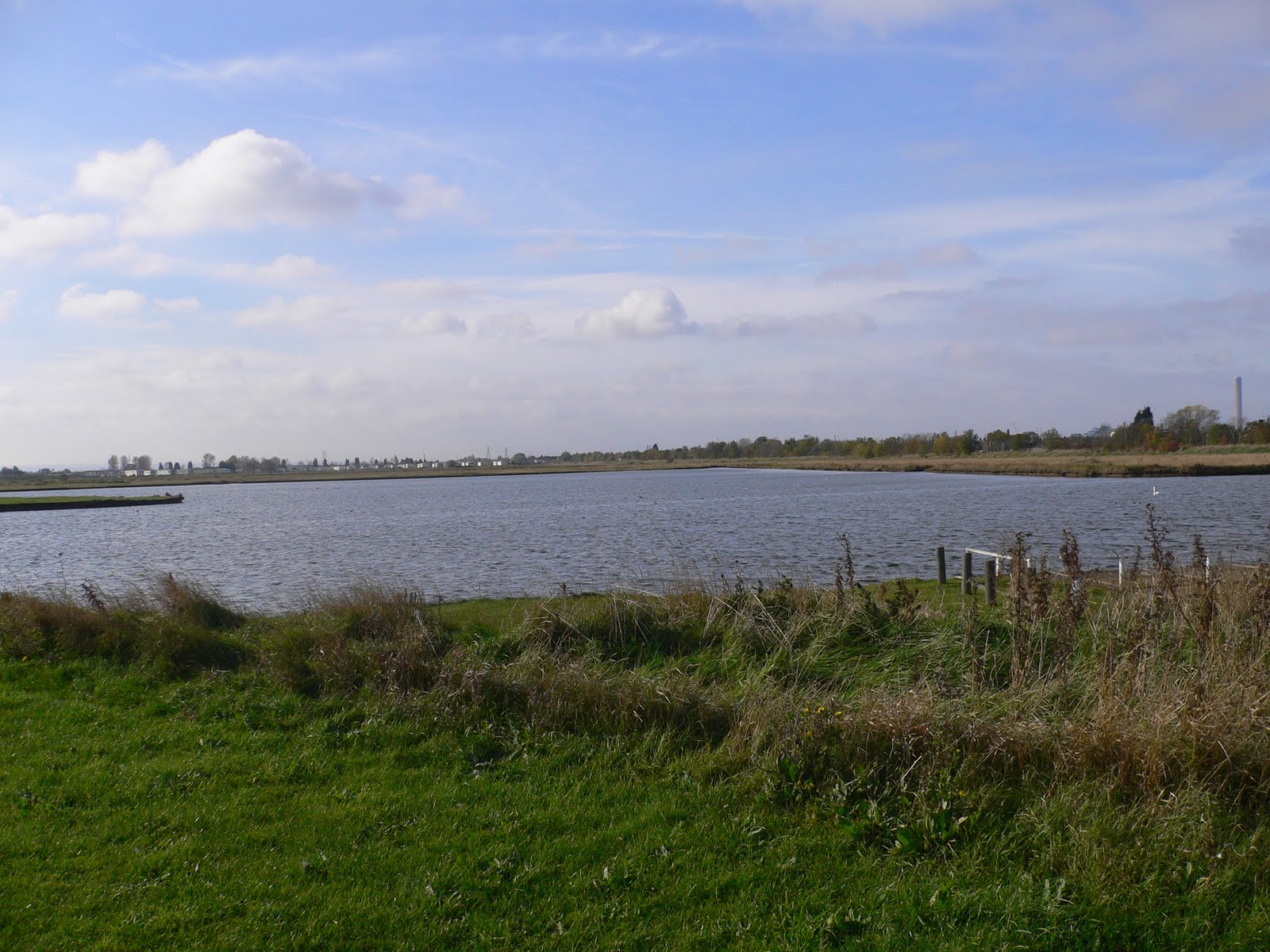

During most winter months both the adjacent canal and the lake, are home to a large number of Little Grebes, often totalling 60+ birds, although apart from a few dozen Wigeon and Oystercatcher and the odd Bar-tailed Godwits and Curlews, that is it. Why it is so attractive to the Little Grebes is hard to know, presumably the sluice allows in large numbers of small fish, or they have created a breeding colony in there.


If you were to turn round in the "Shingle Bank" photo above you would be facing Minster Leas, a stretch of expensively landscaped crumbling cliffs and pedestrian promenade that after a mile or so revert to high, dangerous and ever-eroding cliffs that continue all the way round to Warden Point.
The landscaped stretch of the Leas is very popular with the public for much of the year and despite its slopes tending to be rough and overgrown with various grasses and lucerne and ever increasing shrubs and brambles, it still offers little in the way of wildlife. Apart from a few pairs of Whitethroats in the summer and regular Med. Gulls, birdlife is very limited although there have been two exceptions, a couple of years ago a Dartford Warbler appeared and many years ago, a Blue Rock Thrush!
The only other point of interest along this stretch is the beach below the crumbling cliffs that you can see in the distance, at low tide it has always been a magnet for fossil hunters, with shark's teeth of all sizes being the more commoner finds.

Saturday, 13 November 2010

Quiet Time


Despite going to the reserve most days this week it has been a fairly quiet and unevenful week, wildlife wise. Recent rains have made a difference to the surface of the reserve, softening up the top few inches and where livestock and vehicles have been it has begun to get quite muddy. However, there is still no obvious difference in the ditch levels, which the few visitors that appear remark on.
The photo above shows the wide phragmites reed beds that are alongside the seawall and one morning this week while it was windy I conducted a little experiment to answer a thought that I've often had when passing it, just how snug is it in there when its cold and windy. So, perhaps odd to some people's way of thinking, I made my way into the centre of the reed bed and squatted down and do you know, it was really wind-free and cosy in there, should I get stuck out ther one night, that's where I'll be!

Anyway, getting back to things more appropriate for someone of 63 years of age, we carried out our monthly WEBS count on Wednesday afternoon, in glorious, fairly calm and sunny weather. My section in the middle of the reserve produced one of the poorest counts that I've ever had but the two guys at either end had some really good counts at the two high-tide roosts. The Shellness Point roost had 2,000+ Knot and 5,000+ Oystercatcher alone, apart from the several other species there but it was the guy counting the roost below Harty Church that I most envious of. On the Swale he had a flock of 15 duck and 1 drake Eiders float past. Until about 4 years or so ago these lovely birds used to be a regular feature in the mouth of the Swale but are now rarely seen and still haven't been by me! Another bird that disappeared from the reserve around the same time was the Twite. Every winter we would see small flocks of these plain but delightful finches along the saltings in front of the reserve, differing from the Linnets by their more nasal call and their yellower bills. I quite liked them as a bird.

What else has happened, oh yes, last Saturday Harty had a visit from the Tickham Hunt and they spent most of the day galloping around most of Harty in pursuit of foxes, successfully so I'm told. Anyone who believes this guff about there being a Hunting Ban - something that the Hunt delights in hiding behind and Anti-hunt people are happy to believe is true - ought to witness the now increasingly regular meets on Harty. The huntsmen encourage the hounds to get after a fox, allow them to pursue one and are followed on quad bikes by terrier men ready to dig out and kill any foxes that are "lucky" to evade the hounds.
Personally, I have no problems with the killing of foxes as long as it is done instantly and humanely the second that it is seen, preferably by a rifle. The pursuit of the fox over many miles by the hounds though, until it's lungs give out, is quite sickening, has little to do with pest control and was rightfully "banned".

Lastly, just after dawn this morning, I heard the delightful call of my first Lapland Bunting of the winter as it flew past overhead. Just need a couple of Snow Buntings next.

Sunday, 7 November 2010


Nana my Beagle at the end of the rainbow.

I made my customary dawn visit to the reserve both yesterday and today but little has changed during this last week. The same three/four local wildfowlers were in their usual places on the saltings and once again there was very little for them to shoot at and the total of shots that I witnessed over the two mornings amounted to six and one shot Wigeon. I had a chat with one of them as he returned home along the top of the seawall and he bemoaned the lack of ducks that there are at the moment and suggested that the lack of water on the reserve had much to do with it. I agreed that he was partly right but also pointed out what I thought was patently obvious, that if they continue to turn up and gradually kill what few ducks that are left, then numbers will continue to decrease. Its amazing how the shooting fraternity always fail to accept that simple piece of mathmatics, much preferring to blame other reasons and hope that winter wildfowl will soon arrive and swell the target list.
Heavy rain is also forecast over the next few days so perhaps that will begin to put an inch or two in the ditches and keep us all happy.

Yesterday I had a few doubles bird-wise - 2 S.E.Owls, 2 Barn Owls and 2 ring-tailed Hen Harriers but none of them were about this morning, just Kestrels and Marsh Harriers making up the raptor numbers. Migrant Meadow Pipits, Skylarks and Reed Buntings are currently on or passing through the reserve now and its easy to get flocks of up to 20/30 of each species most mornings. We are due to carry out the monthly WEBS count on Tuesday afternoon and this will give us a better idea of what exactly is, or isn't, on or around the reserve.


Last Monday, like a lot of the Kent birdwatching faternity, I watched the BBC4 programme entitled "Twitching: a British Obsession". As someone who has never liked this side of birdwatching I found that it pretty much lived up to my views on the people that pursue it and made that point on the KOS Forum. Predicatably my comments met with derision and much back-slapping and chumminess from the local twitchers as they stuck together like some kind of old boys' club.
What did amuse me though was a last desperate parting shot from one of them whereby he classified me as a twitcher. Despite the fact that I never go off of Sheppey to birdwatch and haven't even been to nearby RSPB Elmley in the last twenty years, this guy seems to base his logic on the fact that the minute that you leave your own garden to go and look at a bird, that technically classifies you as a twitcher. A bit like saying that as soon as I drive my car off the drive I could be called a racing driver - but if it keeps him happy!

Tuesday, 2 November 2010

SHELLNESS,SHEPPEY

Please note that the previous blog's photos can be viewed much better by double clicking on each one to enlarge them.

SHELLNESS, SHEPPEY

With access to the reserve via the Harty Road denied this morning due to road repairs, I decided to visit the reserve's eastern tip via the Shellness track. With the wind from the South West I was not expecting any seabird movements and so it proved, the light was also quite poor so the pictures are a tad dull. As I walked towards the Point, with the old WWII XDO Post in the foreground, the tide was only just beginning to ebb away from the beach but there was still a surprisingly low high tide roost of birds.


The black dots along the beach are around 500 Oystercatchers, with 3 Cormorants and some gulls as company. It's not unusual at this time of the year for the Oystercatchers to number 2-3,000 birds. As the winter gales increase in regularity the shape of the beach will also change shape as its washed away or built up higher and on really high tides the sea will sometimes cut across the track before the XDO Post for a few hours.

There were 107 Brent Geese drifting along on the ebbing tide, waiting for the weed on the mudflats to become exposed. Out of the 107 only two juveniles were noted, although I believe that in other flocks this winter juvenile numbers have been quite high, so hopefully the breeding season went OK.

Looking back towards the Hamlet from the XDO Post. What an enviable place to live and watch the seasons pass by, plus the ability to carry out a seawatch from your lounge window - something else!

This fence, with attendant signs, was put round the stretch of beach that contains the High Tide Roost and Little Tern nesting areas, asking the public to stay out and the reasons why. Unfortunately eight of the posts have been broken down recently by persons unknown.

Sunday, 31 October 2010

LAST OCTOBER DAY

DAWN BREAKS ACROSS THE SALTING TOWARDS SHELLNESS HAMLET

This morning saw a repeat of yesterday with me being on the seawall in the dark, pre-dawn. The only differences were that clock-wise, I was an hour earlier, and today post-dawn was not all clear blues skies and sunshine, it was very gloomy and eventually turned to steady rain around 07.30.
I love walking across the marsh in the dark, it has a Dickensian feel about it, especially when its damp and murky like today pre-dawn. Today there were more birds getting up in front of me in the dark, I disturbed a few Golden Plovers, Redshanks and the odd Skylark and never saw any of them as they disappeared in the dark, calling as they went. I imagine that wandering across the marsh in the dark like that would be quite daunting to someone doing it for the first time and it does pay to have a good sense of direction (for when its foggy) and where the various ditch crossing points are. Years ago on most marshes there always used to be a network of crossing planks across most ditches that you quickly memorised and made for, they were vital in order to avoid having to walk the long way round lengthy ditches. Nowadays, with most farmers and stockmen prefering to do their livestock "looks" from the insides of a 4x4, these crossing points have been left to rot away or removed.
On top of the seawall in the dark I looked out to The Swale and watched a small yacht making its way out to the open sea, its red, mast-top light like some firefly gliding through the darkness. Soon the yacht was overtaken by a fishing boat with its diesel engines throbbing across the saltings towards me, the sea beginning to come to life, even in the dark.
The speed at which the light suddenly begins to take over always amazes me, at first the merest lightning of a patch of cloud above you, then more and more patches, then distance starts to increase and objects begin to take shape. What I had thought was the dark head of a wildfowler sticking up from a saltings gulley turned out to be a clump of Sea Aster, the bright lights on buildings across on the mainland began to fade into the gloomy dawn light and crows began to appear as they made their way back to Harty from their mainland roosts.
Two Little Egrets silently made their way past over the saltings in front of me, like miniature ghosts, then another two and yet another two, they seem to prefer to be in pairs for some reason.

I could now see about a mile in front of me so time to wander along the seawall for a while, accompanied by the non-stop chorus of Curlews out on the mudflats and the sounds from another fishing boat making its way out to the open sea. This time, two dark shapes did turn out to be two wildfowlers out on the saltings, the same two as yesterday, but with no wildfowl being seen at all they never fired a shot for the two hours that I was out there. Quite clearly it was going to remain gloomy, light-wise this visit and to emphasise that point, at 07.00 it started to spit with rain and so I turned off the seawall and begun to make my way back across another part of the reserve. A few Skylarks passed by overhead, probably incoming migrants, then some Goldfinches and a couple of Greenfinches alighted on some nearby teasel heads with much twittering and activity before carrying on to wherever they were going.

The rain had settled in to become quite steady by then and stood for a while and wistfully watched the drops falling into the shallow waters of a ditch and pondered the fact that tomorrow we start November with water levels lower than they were in July. One long-range forecast this week suggested a mild and dryer winter to come, hopefully the dryer bit won't come true, we do need a lot more rain to make the reserve live up to it's wetland reserve status. I recall that at the beginning of the 1990's we had two dry summers with a dry winter in between and it was disastrous habitat and wildlife-wise.

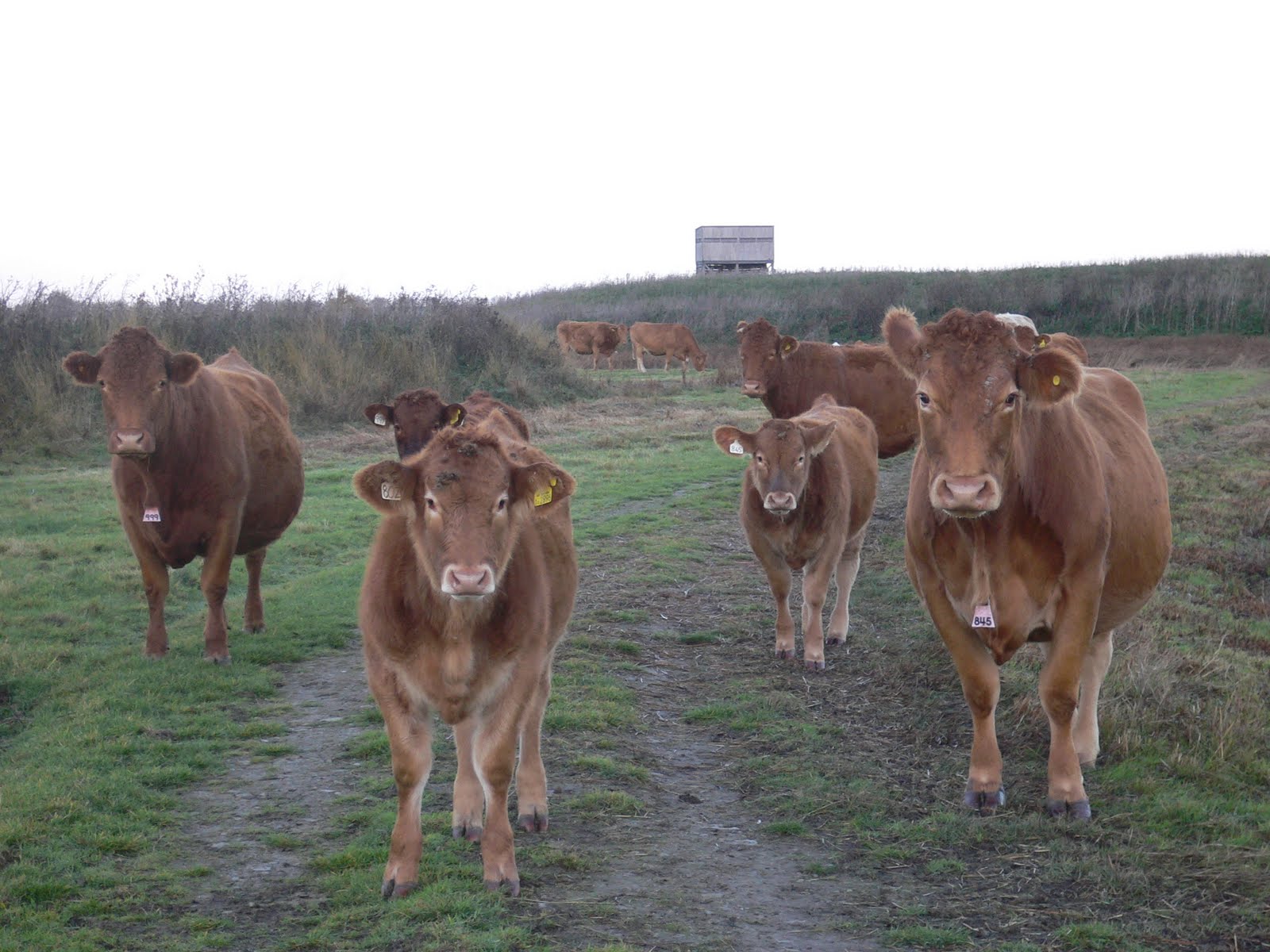
Waking from those ditch-side ponderings I realised that I was getting increasingly wetter and so decided that an early return home was in order and so made my way through the lovely Devon cattle and back to the car.

RECEPTION COMMITTEE (notice the Tower Hide in the background)

Saturday, 30 October 2010

OCTOBER DAWN

For some reason my PC will not allow me to insert photos into this epistle so it's a tad nude, sorry.

I was on the verandah of the Seawall Hide this morning in the dark and waiting for dawn to happen. It was for no particular reason other than than as a habitual early riser I get peed off at this time of the year having to walk around the house waiting so long for it to get light in the mornings. So today I said sod it and left home in the dark. Those lovely, misty, early dawns of 4.00 onwards in the summer seem so far away at this time of the year but thankfully after tonight, we have dawn starting an hour early for a while, joy, why couldn't it be two hours early!

So anyway, there I was, standing in the dark as the first glimmers of light appeared over Shellness, something made easier because of a cloudless sky above. Its surprising how quick that it gets light, a couple of small patches above quickly become a much lighter sky and the visible horizon gets further away by the minute. Lapwings begin to "peewit" to each other, Curlews on the mudflats begin to call, two Water Rails, a hundred yards apart in the reed beds "mew" to each other and a light breeze stirs the reedbed tops.

As it gradually became much lighter I was startled to find that I was not alone in this space, just a hundred yards away on the saltings in front of me were the heads of two wildfowlers. Scary, but that's how it is on the Swale nature reserves these days and to emphasise that fact, just fifteen minutes later, two really loud gunshots echoed around The Swale as shooters shot at something from what sounded like the seawall of the Oare reserve, a mile or so away. Judging by the depth of sound that the shots created I imagine that they must of been using the more powerful cartridges designed to kill geese, perhaps Oare has lost a goose or two.

The light increased by the minute to expose a lovely blue sky and Bearded Tits "pinged" in the reedbeds alongside me as I made my way back to the top of the seawall and headed towards Shellness. Before I got that far though, I decided to cut back across the farmland and re-enter the reserve in it's northern corner. As I got there Mallard had begun leaving their corn-fed ditches below Muswell Manor and were dropping into one of the reserve's boundary ditches, don't know why, we don't feed them, but they're very welcome.

I walked back across the reserve, through the cattle that were reluctant to stand aside as Midge and I walked through them, past the old Salt Workings mounds that used to be home to hundreds of rabbits but now house none and headed towards the car.
What of birds - well there were some of the usuals about - Kestrels, Harriers, Coots, ducks, Greylags and some buntings and finches but nothing out of the ordinary and I'll leave it to other Blogs to write long lists of all the same stuff every day, surely it must get boring?