Tuesday, 16 November 2010

Frost and Mist and all things Ice

Double click on the photoes to bring them up in better detail.


Earlier today on the reserve was one of those superbly scenic times that you would almost pay to experience. A hard frost, clear blue skies, not a breath of wind and a great yellow sun that was just beginning to create the hint of mist across the marshes. On my way there I stopped on Capel Hill and took the photo above which looks down to Capel Corner, Capel Fleet and the flatness of the Harty Marshes. The sun was just appearing above the horizon to the east.
Apart from the obvious visual delights of such a morning there is the clarity of sound, bird calls are magnified and carry for so much further. All along the mudflats of The Swale the "barking" of many hundreds of Brent Geese could be heard really clearly and these were echoed by the farmyard gabbling of the Greylag Geese flock, back in the same place as yesterday. I could even quite clearly here a train as it sped through the countryside a few miles away on the mainland, bound for East Kent no doubt.


As I made my way through the cattle herd they briefly stopped to watch me go by before returning to their grazing, they must have well coated teeth to be able to take a mouthful of frost with each mouthful of grass - no microwaves out there to warm things up!
Having said that, by 9.00 the sun had become surprisingly warm and was steadily melting the frost on the south facing banks of the mounds and ditches, leaving that delightful two-tone effect of green and white.


Sunday's rain hadn't made much difference to the ditch levels but there was a small increase and so I decided to put the static pump on and begin to put a little water onto the field known as "The Flood", because it does become our main flood area in the winter. I illustrated this in its dry state in a previous blog and now began to wetten it down ready to receive further rains. In the foreground of the photo below you can see the water bubbling up from the underground pipe.
Whilst standing there watching the water (water fascinates me - the legacy of being a Cancerian I suppose) I watched several small flocks of Skylarks fly in and begin feeding in the weedy areas around the water. Eventually there was a flock of some 40 birds and then, right on cue, a Snipe zoomed in and began working its way across the shallow water - triffic!


Close by to the pump shed is the Tower Hide, seen below, so I wandered over to that for a look round while I was pumping. Its a tad old now but easily gives the best views across not only across the reserve but the surrounding farmland, across the Swale to the mainland and out to Shellness Point. One regular feature of using this hide is the ability to sit there with the flaps open and have a harrier glide by, literally within a couple of feet of you. I remember one time when a Hobby, not realising that I was inside, used the roof as a perch and at regular intervals stooped down past the open flaps to snatch dragonflies from the air.
Even better, back in the late 1980's, I was sitting in there when in the field immediately in front of it, I realised that I was looking at an Oriental Collared Pratincole and a Black-winged Pratincole, both together!
All special memories and a couple of years ago I also added Collared Pratincole to the reserve list, all three whilst doing my ordinary daily patrols, who needs to rush up and down the country!

Monday, 15 November 2010

Toe Tingling


After raining all day yesterday it promptly froze overnight making even getting a frozen car door open difficult. This was also the case when I arrived at the reserve, I had to spray de-icer into the entry gate lock before I could get the key to turn.
The sun hadn't yet appeared from behind some low cloud and the scene above greeted me as I stepped through the 5-bar gate and onto the marsh. (Double click the photo to enlarge it and it looks almost lunar like)
Further round the reserve, just as the sun started to appear, it began to light up the tiny Harty Church, across a frozen field of rape. It sits all on its own alongside a farmhouse and barn and has great views down onto The Swale below.


Enlarge the photo below and you see part of the Greylag Geese flock that are pretty much resident on the reserve, peak counts total around 400 birds. Generally they leave the reserve pre-dawn and go out to the neighbouring farmland for an hour or two before returning in several noisy and spectacular skeins, to spend most of the day roosting in this same spot. Just behind them you can see a couple of small bushes on top of the seawall, behind which the wildfowlers wait and hope to shoot a few. In the summer when several pairs have bred, they form large creches of goslings that sometimes have just a couple of adults looking after them.

Later as I walked back across the reserve it is plain to see that the sun had done a good job of thawing the frost and this photo shows one of several old Salt Workings mounds that there are on the otherwise flat marsh. I have never been able to find out exactly what function that these mounds had in the process of producing the salt. Obviously a few centuries ago, before the seawall was built, these grazing fields would of been little more than saltings that were regularly covered by high tides.
I imagine that once salt water was trapped after one of these tides then it was simply a matter of letting it evaporate in order to leave behind its salt content as you see in various salt pans when abroad. Possibly these mounds are the spoil from creating these flooded pans, although there is no evidence these days around the mounds of any such depressions nearby. On maps of Sheppey there are numerous of these "salt workings" marked across the marshes and in more recent times they have also served as livestock saviours on the odd occasion that the sea has breached the seawall and flooded the marshes.

Sunday, 14 November 2010

Minster Beach


I have mentioned the Minster beach area on Sheppey in a previous blog but not with photos. It is on Sheppey's northern coast and faces the Thames Estuary and the Essex shore.
The "Shingle Bank" shown above is only a short stretch of artificialy created bank that borders the road between Minster and Sheerness and is the first line of flood protection. Prior to 1960 the short stretch of road that you can see was not there, it was basically an unmade, pot-holed track, subject to flooding by the sea and unsuitable for ordinary traffic. The main seawall was the one to the left of the picture (double click to enlarge the photo) and old photos show the area between it and the beach as primarily just something similar to salt marsh. Behind the older seawall was a large stretch of marshland, which is still there, which was used as a military firing range. Huge targets were in place a short way behind the seawall and when firing torwards them was taking place, military guards at each end of the seawall would direct the walking public through a long "covered way" that was between the seawall and the targets.
The current "Shingle Bank" is used most days throughout the year by windsurfers, kite-boarders, fishermen, but occasionally throws up some interesting bird life and has an impressive list of wild flowers. In hard weather Snow Buntings can be found there and I actually saw my very first Snow Bunting there when the bank was first being created in around 1959/60. Despite the constant daily disturbance, a few years ago a pair of Little Terns somehow managed to rear a brood of chicks there, regularly shepherding their chicks further along the beach away from large groups of picknicking and windsurfing families. At high tide in the winter months there are also good-sized roosts of mixed waders there along the water's edge, birds such as Sanderling, Ringed Plovers and Turnstones, sometimes in many hundreds.
Wild flowers along this bank are numerous and feature Lucerne, Yellow-horned Sea Poppy, Sea Kale, Sea Campion and the rarer Dragon's Teeth, as some of the more uncommoner ones.
At the far end of the "Shingle Bank" and the road, is the entrance to what used to be the old firing range and which has now been landscaped into a country park, known as Bartons Point Country Park. This park is seperated from Sheerness by an old canal of several miles, that was created in Napoleonic times to enable Sheerness and its military garrisons to be defended from all sides. Unfortunately the section of the canal adjacent to the park has its water levels maintained by regular topping up with seawater through a sluice at its seaward end and this has created a stretch of water that is pretty much useless to most forms of fresh-water loving wildlife. The flipside being that it does now have an active population of both jellyfish and cockles that have entered with the sea water and bred successfully.
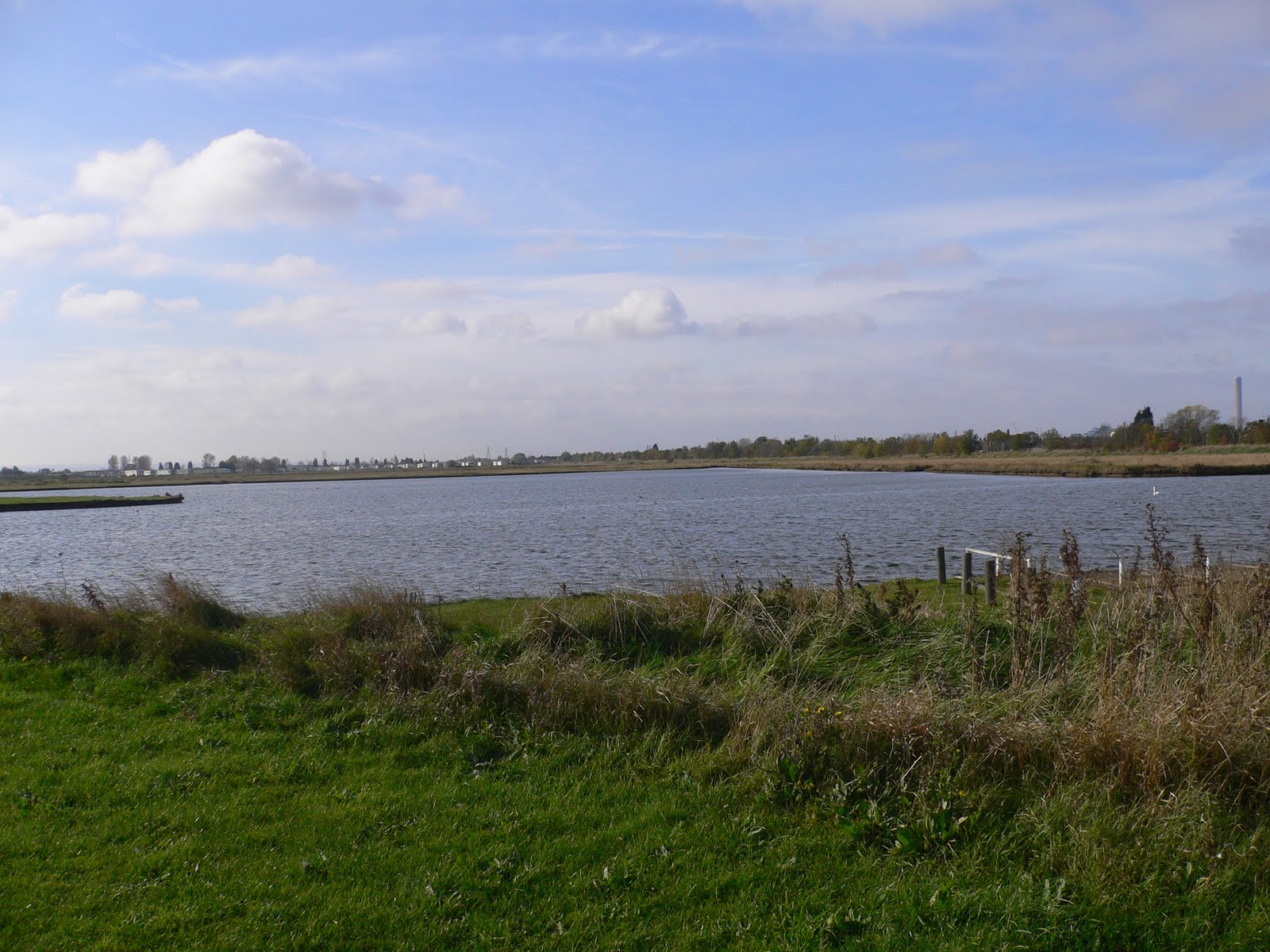
When the park was created a large lake, unfortunately fed by seawater from the canal, was also created.


During most winter months both the adjacent canal and the lake, are home to a large number of Little Grebes, often totalling 60+ birds, although apart from a few dozen Wigeon and Oystercatcher and the odd Bar-tailed Godwits and Curlews, that is it. Why it is so attractive to the Little Grebes is hard to know, presumably the sluice allows in large numbers of small fish, or they have created a breeding colony in there.


If you were to turn round in the "Shingle Bank" photo above you would be facing Minster Leas, a stretch of expensively landscaped crumbling cliffs and pedestrian promenade that after a mile or so revert to high, dangerous and ever-eroding cliffs that continue all the way round to Warden Point.
The landscaped stretch of the Leas is very popular with the public for much of the year and despite its slopes tending to be rough and overgrown with various grasses and lucerne and ever increasing shrubs and brambles, it still offers little in the way of wildlife. Apart from a few pairs of Whitethroats in the summer and regular Med. Gulls, birdlife is very limited although there have been two exceptions, a couple of years ago a Dartford Warbler appeared and many years ago, a Blue Rock Thrush!
The only other point of interest along this stretch is the beach below the crumbling cliffs that you can see in the distance, at low tide it has always been a magnet for fossil hunters, with shark's teeth of all sizes being the more commoner finds.

Saturday, 13 November 2010

Quiet Time


Despite going to the reserve most days this week it has been a fairly quiet and unevenful week, wildlife wise. Recent rains have made a difference to the surface of the reserve, softening up the top few inches and where livestock and vehicles have been it has begun to get quite muddy. However, there is still no obvious difference in the ditch levels, which the few visitors that appear remark on.
The photo above shows the wide phragmites reed beds that are alongside the seawall and one morning this week while it was windy I conducted a little experiment to answer a thought that I've often had when passing it, just how snug is it in there when its cold and windy. So, perhaps odd to some people's way of thinking, I made my way into the centre of the reed bed and squatted down and do you know, it was really wind-free and cosy in there, should I get stuck out ther one night, that's where I'll be!

Anyway, getting back to things more appropriate for someone of 63 years of age, we carried out our monthly WEBS count on Wednesday afternoon, in glorious, fairly calm and sunny weather. My section in the middle of the reserve produced one of the poorest counts that I've ever had but the two guys at either end had some really good counts at the two high-tide roosts. The Shellness Point roost had 2,000+ Knot and 5,000+ Oystercatcher alone, apart from the several other species there but it was the guy counting the roost below Harty Church that I most envious of. On the Swale he had a flock of 15 duck and 1 drake Eiders float past. Until about 4 years or so ago these lovely birds used to be a regular feature in the mouth of the Swale but are now rarely seen and still haven't been by me! Another bird that disappeared from the reserve around the same time was the Twite. Every winter we would see small flocks of these plain but delightful finches along the saltings in front of the reserve, differing from the Linnets by their more nasal call and their yellower bills. I quite liked them as a bird.

What else has happened, oh yes, last Saturday Harty had a visit from the Tickham Hunt and they spent most of the day galloping around most of Harty in pursuit of foxes, successfully so I'm told. Anyone who believes this guff about there being a Hunting Ban - something that the Hunt delights in hiding behind and Anti-hunt people are happy to believe is true - ought to witness the now increasingly regular meets on Harty. The huntsmen encourage the hounds to get after a fox, allow them to pursue one and are followed on quad bikes by terrier men ready to dig out and kill any foxes that are "lucky" to evade the hounds.
Personally, I have no problems with the killing of foxes as long as it is done instantly and humanely the second that it is seen, preferably by a rifle. The pursuit of the fox over many miles by the hounds though, until it's lungs give out, is quite sickening, has little to do with pest control and was rightfully "banned".

Lastly, just after dawn this morning, I heard the delightful call of my first Lapland Bunting of the winter as it flew past overhead. Just need a couple of Snow Buntings next.

Sunday, 7 November 2010


Nana my Beagle at the end of the rainbow.

I made my customary dawn visit to the reserve both yesterday and today but little has changed during this last week. The same three/four local wildfowlers were in their usual places on the saltings and once again there was very little for them to shoot at and the total of shots that I witnessed over the two mornings amounted to six and one shot Wigeon. I had a chat with one of them as he returned home along the top of the seawall and he bemoaned the lack of ducks that there are at the moment and suggested that the lack of water on the reserve had much to do with it. I agreed that he was partly right but also pointed out what I thought was patently obvious, that if they continue to turn up and gradually kill what few ducks that are left, then numbers will continue to decrease. Its amazing how the shooting fraternity always fail to accept that simple piece of mathmatics, much preferring to blame other reasons and hope that winter wildfowl will soon arrive and swell the target list.
Heavy rain is also forecast over the next few days so perhaps that will begin to put an inch or two in the ditches and keep us all happy.

Yesterday I had a few doubles bird-wise - 2 S.E.Owls, 2 Barn Owls and 2 ring-tailed Hen Harriers but none of them were about this morning, just Kestrels and Marsh Harriers making up the raptor numbers. Migrant Meadow Pipits, Skylarks and Reed Buntings are currently on or passing through the reserve now and its easy to get flocks of up to 20/30 of each species most mornings. We are due to carry out the monthly WEBS count on Tuesday afternoon and this will give us a better idea of what exactly is, or isn't, on or around the reserve.


Last Monday, like a lot of the Kent birdwatching faternity, I watched the BBC4 programme entitled "Twitching: a British Obsession". As someone who has never liked this side of birdwatching I found that it pretty much lived up to my views on the people that pursue it and made that point on the KOS Forum. Predicatably my comments met with derision and much back-slapping and chumminess from the local twitchers as they stuck together like some kind of old boys' club.
What did amuse me though was a last desperate parting shot from one of them whereby he classified me as a twitcher. Despite the fact that I never go off of Sheppey to birdwatch and haven't even been to nearby RSPB Elmley in the last twenty years, this guy seems to base his logic on the fact that the minute that you leave your own garden to go and look at a bird, that technically classifies you as a twitcher. A bit like saying that as soon as I drive my car off the drive I could be called a racing driver - but if it keeps him happy!

Tuesday, 2 November 2010

SHELLNESS,SHEPPEY

Please note that the previous blog's photos can be viewed much better by double clicking on each one to enlarge them.

SHELLNESS, SHEPPEY

With access to the reserve via the Harty Road denied this morning due to road repairs, I decided to visit the reserve's eastern tip via the Shellness track. With the wind from the South West I was not expecting any seabird movements and so it proved, the light was also quite poor so the pictures are a tad dull. As I walked towards the Point, with the old WWII XDO Post in the foreground, the tide was only just beginning to ebb away from the beach but there was still a surprisingly low high tide roost of birds.


The black dots along the beach are around 500 Oystercatchers, with 3 Cormorants and some gulls as company. It's not unusual at this time of the year for the Oystercatchers to number 2-3,000 birds. As the winter gales increase in regularity the shape of the beach will also change shape as its washed away or built up higher and on really high tides the sea will sometimes cut across the track before the XDO Post for a few hours.

There were 107 Brent Geese drifting along on the ebbing tide, waiting for the weed on the mudflats to become exposed. Out of the 107 only two juveniles were noted, although I believe that in other flocks this winter juvenile numbers have been quite high, so hopefully the breeding season went OK.

Looking back towards the Hamlet from the XDO Post. What an enviable place to live and watch the seasons pass by, plus the ability to carry out a seawatch from your lounge window - something else!

This fence, with attendant signs, was put round the stretch of beach that contains the High Tide Roost and Little Tern nesting areas, asking the public to stay out and the reasons why. Unfortunately eight of the posts have been broken down recently by persons unknown.